Fast connectivity becomes an important requirement in modern embedded devices. As AI workloads and high-resolution image streams are more present, network throughput becomes an increasingly limiting factor. At the same time, most available System-on-Chips and System-on-Modules provide an Ethernet speed of 1 Gbps as the default communication interface.
A while back, we described the general rationale behind combining 10GbE communication interfaces with embedded platforms, using off-the-shelf 10GbE adapter cards with Jetson Nano/NX as an example. Today, we present Antmicro’s open hardware OCuLink-to-10 GbE Adapter, designed to enable fast Ethernet connectivity while maintaining a small form factor and modularity, which are crucial factors in the integration of embedded systems.
Lowering the mechanical outline while simultaneously increasing data bandwidth poses a challenge in thermal management. The high-throughput communication interfaces dissipate a substantial amount of heat which needs to be tackled for reliable operation of the system as a whole.
This article describes the features of Antmicro’s OCuLink-to-10GbE Adapter, outlines example use cases for data collection behind situation awareness, vision processing and data fusion applications, and presents related thermal tests of the proposed passive cooling aperture.
OCuLink-to-10 GbE Adapter overview
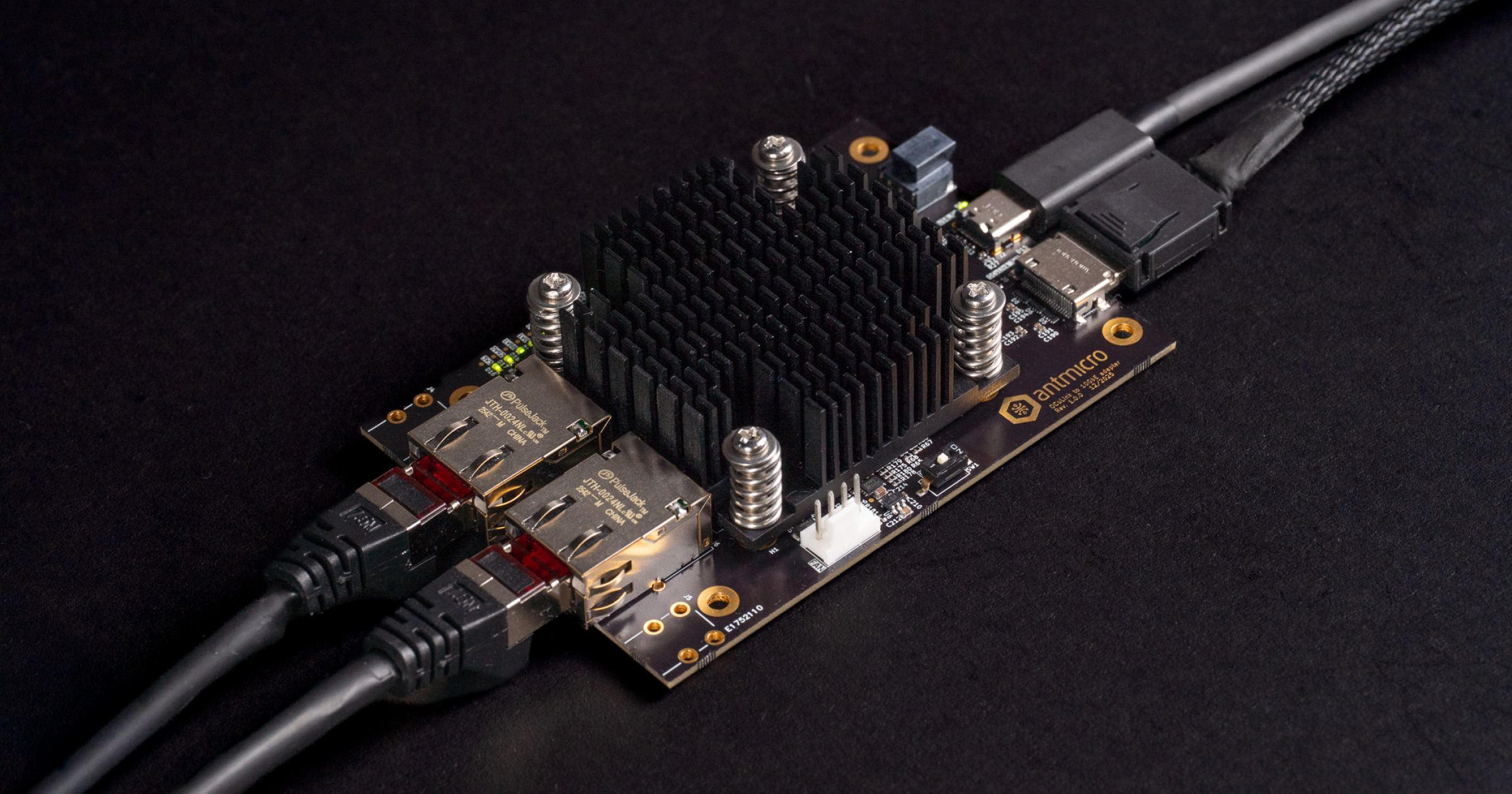
The OCuLink-to-10GbE Adapter is an open hardware PCB reference design for a standalone Network Interface Card (NIC) based on the Intel X710-AT2 Ethernet controller with two RJ45 ports, each offering 10GBASE-T connectivity. The on-board Intel X710-AT2 controller, according to the product page, operates as a PCIe endpoint device exposed over a 4-lane PCIe Gen 3.0 interface. This PCIe interface has been routed to the OCuLink connector, which makes it possible to install the OCuLink-to-10 GbE Adapter at some distance from the host device. The Intel X710-AT2 controller enumerates over PCIe as two independent Ethernet interfaces at the host side, which allows implementing it in various networking use cases, backed with custom routing policies.
The PCB is compact-sized with an outline of 70 x 100 mm (2.76 x 3.94 inch), which can be further optimized for space-constrained applications. The X710-AT2 part itself is offered in a 22x22mm BGA package.
Since the OCuLink interface standard does not include power rails, the OCuLink-to-10 GbE Adapter needs to be powered from an external power source. The board accepts 12V DC power via a Molex Nano-Fit locking wire-to-board connector. It is also possible to use the board with standard wall adapters equipped with a USB-C plug. The average measured power consumption of the X710-AT2 while working with two 10GbE ports is around 7.2 W.
The OCulink-to-10 GbE Adapter card can be used with regular PC-based hosts. For such an application you need to equip the PC motherboard with an M.2-to-OCuLink adapter or use a custom PCIe card/riser with an OCuLink port. It is also possible to use the card with embedded platforms such as Antmicro’s COM Express 7 Baseboard or the Antmicro Baseboard for Jetson Orin series of System-on-Modules. For the latter application, we prepared an example setup and showcased it in our System Designer portal:
In addition, we extended our meta-antmicro Yocto layer with a driver supporting the Intel X710-AT2 controller for use with the Antmicro Baseboard for Jetson Orin.
Applications of the OCuLink-to-10 GbE Adapter
The OCuLink-to-10 GbE Adapter includes a dual-port 10GbE controller which provides high, low-latency throughput that you can use, for example, to cluster embedded devices that require fast, reliable inter-device connectivity. The same goes for advanced data acquisition scenarios, where high throughput translates into improved efficiency of the system.
The OSHW OCuLink-to-10 GbE Adapter design should be treated primarily as a technology demonstrator. Antmicro offers a broad range of design customization and end-to-end product development services as part of our commercial offering. Design customization may include altering the mechanical outline, changing the IO ports, or altering the power supply scenarios by adding PoE-source/sink circuitry. It is also possible to combine the X710-AT2 application with a host processing platform into a compact-sized, single-board design.
The adapter’s design customization options combined with the versatility of the 2-port GbE with PCIe interconnect allows using the 10GbE interface for a variety of applications. Interfacing with high-speed cameras (including hyperspectral imaging), radars, passing high-resolution data for edge AI inference for navigation and situation awareness, CI-driven hardware in the loop testing setup or clustering of embedded platforms are just a few examples of potential use cases we are exploring with our customers.
10GbE throughput measurements
In order to ultimately validate the adapter’s performance, we have measured its data throughput. The test setup consisted of an NVIDIA Jetson Orin NX SoM, the Antmicro Baseboard for Jetson Orin and the OCuLink-to-10 GbE Adapter, connected via the M.2-to-OCuLink Adapter to either the PCIe x4 M.2 connector or the PCIe x1 M.2 connector on the Storage Expansion Board. The Ethernet medium was directly connected to a PC with a 10 GbE Intel card, running iperf3 TCP/IP server in TCP/IP mode.
| OCuLink PCIe Gen 3 x1 [TX/RX Gbps] | OCuLink PCIe Gen 3 x4 [TX/RX Gbps] | |
|---|---|---|
| Simplex | 6.45 / 3.4 | 9.88 / 9.88 |
| Full duplex | 6.34 / 3.04 | 9.88 / 9.88 |
| Dual port, full duplex | 3.15 / 1.76 (each port) | 6.44 / 4.78 (each port) |
While the adapter can operate with either 1- or 4-lane PCIe connection, the first option causes a noticeable bottleneck. The 4-lane connection allowed the card to operate at its full 10GBASE-T port capacity. In the “dual port” scenario, we ran a full-duplex test on both 10GBASE-T ports simultaneously. While the total data exchange exceeded 20 Gbps, the throughput per port was lower than in the “single port” test. This can be attributed to the high load of one Jetson Orin SoM CPU cores while handling the Ethernet transactions.
Thermal performance
The 10GBASE-T physical layer may constitute a significant heat source. Bringing 10GbE connectivity on board of a compact-sized embedded system can make choosing an optimal cooling solution for such a device quite the challenge. In particular, 10GbE interfaces operating under a constant load in embedded devices installed in harsh environments (i.e. exposed to extreme temperatures, with limited space available for ventilation) are more than likely to overheat over time, leading to unstable operation and connectivity loss.
Antmicro is actively developing an automated, open source-driven flow for performing thermal simulations to help solve such challenges in the early stages of the product development process. Much like we do in customer projects, we used this flow to simulate the temperature of the on-board Intel X710 with the Advanced Thermal Solutions ATS-61500R-C2-R0 cooling solution proposed for the OCuLink-to-10GbE Adapter. While the ATS-61500R-C2-R0 component supports an axial fan, we conducted the current analysis with passive cooling only, with no fan included.
The thermal simulation assumed cooling by natural convection at an ambient temperature of 25°C. The Intel X710 part in the simulation was set to dissipate power of 9.5 W, which is the Total Dissipated Power (TDP) of that part provided on its product page. The graph below shows the simulated temperature change over time of the Intel X710-AT2 Ethernet controller under full load:
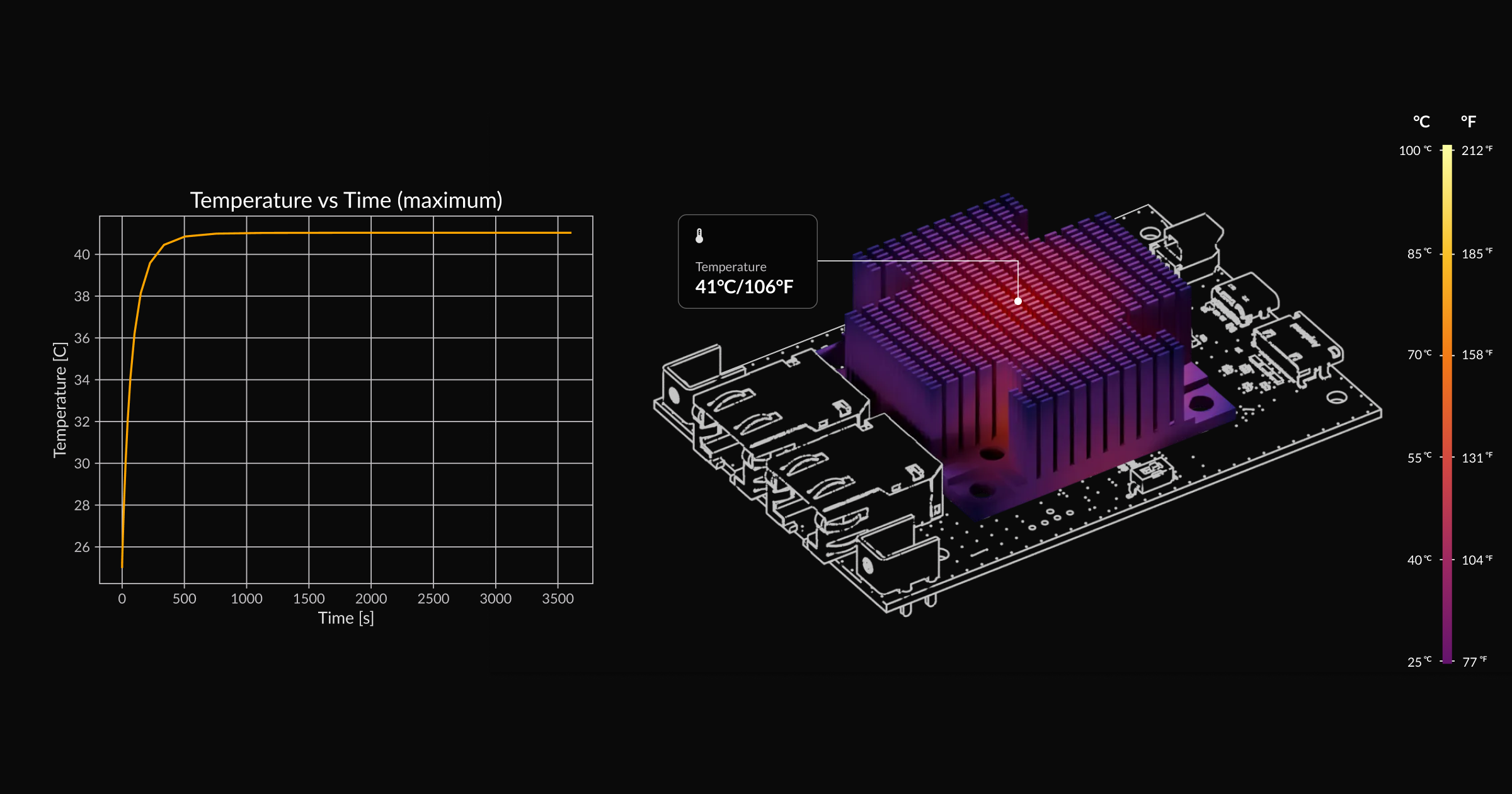
The results show that, for the evaluated heat spreader, passive cooling would be sufficient to keep the adapter within the X710-AT2 recommended operating temperature range.
Bring a 10GbE interface to your next product
Antmicro’s latest OCuLink-to-10 GbE Adapter provides an open hardware design of a 2-port 10GbE Network Interface Card (NIC) based on an Intel X710-AT2 controller. The open hardware design has been verified with prototypes that were validated with host devices implemented as regular PCs and embedded Antmicro Baseboards for Jetson Orin System-on-Modules. The OCuLink-to-10 GbE Adapter is compatible with an entire range of OCuLink accessories developed by Antmicro.
A 10GbE interface reduces the data throughput limitation which affects the performance of some modern embedded platforms. Additional 10GbE ports bridged to an embedded platform over PCIe offer high-end, reliable Ethernet connectivity to peripheral devices such as high-resolution cameras, network-attached storage or clustered computational nodes in a clustered and distributed networking environment.
The reference application of the X710-AT2 dual 10GbE controller on the OCuLink-to-10 GbE Adapter can be easily modified in terms of mechanical arrangement, IO connectors or supported scenarios of power supply distribution. In particular, such modifications may include combining the 10GbE interface with PoE sink/source controllers for versatile applications.
If you are looking to develop your next edge AI product and want to combine it with high-throughput and low latency 10GbE interface, reach out to us at contact@antmicro.com to discuss how our services can help you achieve your goals in shorter time to market.