Verilator is an extremely popular open source simulator, used in a number of ASIC and FPGA workflows where its default two-state operation model (i.e. only representing the logic values of 1 and 0) is enough. While two-state simulation is much faster and memory-efficient, and sufficient for many applications such as functional testing and debugging, when dealing with initialization bugs or high-impedance states, four-state simulation (which supports logic values of 1, 0, x and z) becomes necessary.
Antmicro has been a major contributor to Verilator for a while now, gradually introducing important features such as UVM support and constrained randomization, and collaborating with other contributors to expand the open source ASIC development ecosystem, with significant efforts converging within the recently restructured SV Tools Project of CHIPS Alliance, an open source silicon organization running under the auspices of the Linux Foundation.
Recently, we have been working on implementing four-state logic in Verilator. Due to its complexity, the project will require an ongoing effort spread across multiple PRs and months. However, an important initial milestone has already been reached, as visible in the initial PR we have opened that will serve as a starting point for further development. In this article we explain the rationale behind adding four-state logic in Verilator and describe the current status of the implementation.
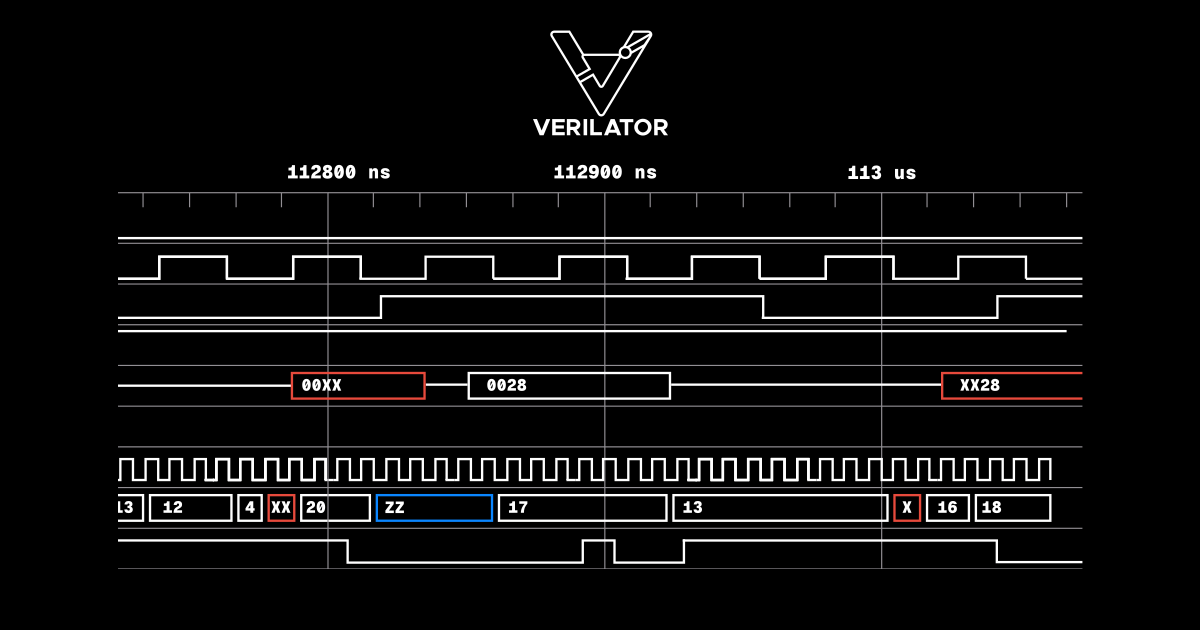
More accurate simulation and debugging with four-state logic
In SystemVerilog, many data types can have four-state values. Four-state logic allows for more accurate hardware simulation as it supports not only 0 and 1 states, but also z (high impedance) and x (unknown value). High impedance usually means an unconnected or floating wire. An unknown value could mean either 1 or 0, but it can also indicate potential design flaws, e.g. bus contention.
As ambiguous values (x and in some cases z) tend to spread throughout the simulation, four-state logic makes it easier to spot them during debugging.
For example, let’s take a look at the following SystemVerilog snippet:
logic val1;
logic val2 = val1 & 1;
Without four-state logic, during simulation val1 may take the value of 0 or 1 (depending on the configuration), since it is uninitialized. val2 will also take the value of 0 or 1, which at first glance may seem correct. But with four-state logic, val1 will be equal to x and as a result, val2 will be equal to x as well, which makes it obvious that this is not a valid value.
Four-state logic also allows detecting wires connected to high and low states at the same time:
wire val;
assign val = 1;
assign val = 0;
// val is x because of ambiguity
Implementing four-state logic in Verilator
In order to avoid the need to reimplement a vast number of Verilator’s existing optimizations that are applied early in the verilation process, four-state variables are split into two two-state variables which are already supported and operations on which are greatly optimized. In practice, this means that for the most part, Verilator works independently of the four-state logic implementation, making maintenance easier and accelerating further development.
In the proposed implementation, four-state logic in Verilator is available under an experimental --fourstate flag. By default, four-state logic is disabled. For the sake of forward compatibility, we also added a --no-fourstate flag that can be used to disable four-state logic support in favor of two-state logic.
logic val1 = 1;  // will turn into:   bit val1_value = 1;
                                      bit val1_xz = 0;
logic val2 = 'z;  // will turn into:  bit val2_value = 0;
                                      bit val2_xz = 1;
logic val3 = val1 & val2;  // into:   bit val3_value = (val1_value | val1_xz)
                                                     & (val2_value | val2_xz)
                                      bit val3_xz = (val1_value & val2_xz)
                                                  | (val2_value & val1_xz)
                                                  | (val1_xz & val2_xz)
// Result: val3_value == 1
//         val3_xz == 1
//         val3 == 'x
For more details about the implementation, refer to the GitHub Pull Request.
Towards full four-state logic support in Verilator
The developments described in this article constitute just the first step on the way towards full four-state logic support in Verilator. We’re currently working on more features, such as four-state support in arrays and queues, and scheduler adjustments, which we’ll describe in future articles.
If you would like to learn more about Antmicro’s engineering services around Verilator, contact us at contact@antmicro.com. You can also join us at FOSSi Foundation’s Latch-Up conference taking place in Waterloo, Canada on 1-3 May 2026, where we’ll be presenting our recent contributions to the Verilator project, including four-state logic support, as well as our work within the recently restructured CHIPS Alliance SV Tools Project.