As long-time contributors to the Zephyr Project, Antmicro actively participates in the efforts to facilitate the use of the Zephyr RTOS in AI applications, as in the case of the Zephelin AI profiling library developed in partnership with Analog Devices. Porting Zephyr to new, AI capable platforms is another typical software service Antmicro provides, backed by years of experience in adding, testing, and maintaining support for various silicon devices.
Today, we are happy to announce support for the first Synaptics platform in Zephyr, the AI-native Astra SR100 MCU series. In this brief article we will describe the SR100 family, the scope of the Zephyr support, and an outlook towards our joint work with Synaptics around the exciting next-gen Astra SL2610 series, powered by Google’s RISC-V Coral NPU.
Synaptics Astra Embedded Processors
The continuously growing family of Synaptics Astra Embedded Processors focuses on providing transformer-capable AI, high efficiency, and secure, scalable compute for the IoT edge.
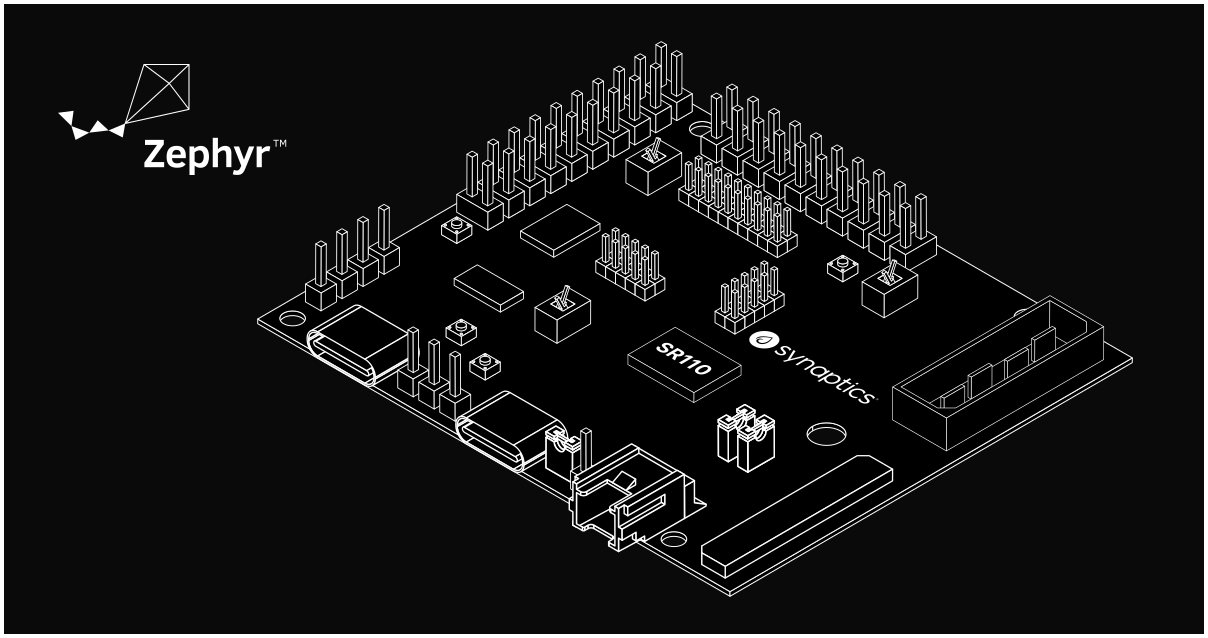
The current Synaptics Astra SR100 series comes in three variants: single-core SR102 and SR105, and dual-core SR110. The energy-efficient SR110 MCU combines ultra-low power (ULP) architecture with on-device AI workloads, enabling vision and audio processing even on battery-powered devices. It includes an Arm Cortex-M55 CPU and an Arm Ethos-U55 NPU, complemented by an additional low-power Cortex-M4 coprocessor, which together provide the necessary processing power for applications such as robotics, battery-operated systems, and security sensors.
Since Zephyr RTOS was designed to run on resource-constrained devices and offers features facilitating the development of AI applications, it’s a perfect match for the SR100 series. With Antmicro’s broad experience in not only upstreaming and maintaining SoC support for silicon vendors but also building full products with Zephyr, we were happy to help introduce the SR100 series to Zephyr.
While the Astra SR100 series currently supported in Zephyr already was designed as a new class of efficient platforms for multimodal AI on IoT devices, the upcoming next-gen Astra SL2610 series is unique in that it will be the first market solution to integrate the RISC-V Coral NPU from Google, providing even better performance and the possibility to tap into Coral’s emerging open source ecosystem. Alongside Synaptics, Antmicro has also partnered with Google to extend that ecosystem, focusing on developing ML compilers and helping customers adopt the Coral platform in their SoCs. Taking advantage of tools such as the Kenning AI benchmarking framework and the Renode simulator, Antmicro services facilitate efficient development of cutting edge AI-aware products.
Adding Zephyr support for the SR100 AI MCU series
The Zephyr implementation for the SR100 series is now available on GitHub and includes support for Synaptics SR100 SoCs, the SR100 Astra Machina Micro (RDK) Board, and Synaptics-specific drivers.
The changes consist of:
- clock control driver
- pinctrl driver
- reset driver
- AON GPO driver
- support for the SR100 SoC family
- support for the SR100-RDK board
With the initial implementation of the SR100 support in place, we look forward to seeing more Synaptics platforms adopted in the Zephyr RTOS ecosystem.
The SR100 RDK platform is also available in Antmicro’s System Designer where you can find various Zephyr samples, along with Renode execution traces, logs, and more.
Develop your next AI-aware IoT device with Antmicro
Antmicro can help you not only bring Zephyr to your platform but also ensure it’s thoroughly tested at every stage of the project. By employing tools such as the Zephelin AI profiling library or the AutoML VS Code plugin, we provide scalable workflows that help our customers rapidly develop market-ready AI solutions for constrained devices. If you would like to learn more about Antmicro’s services, don’t hesitate to contact us at contact@antmicro.com.