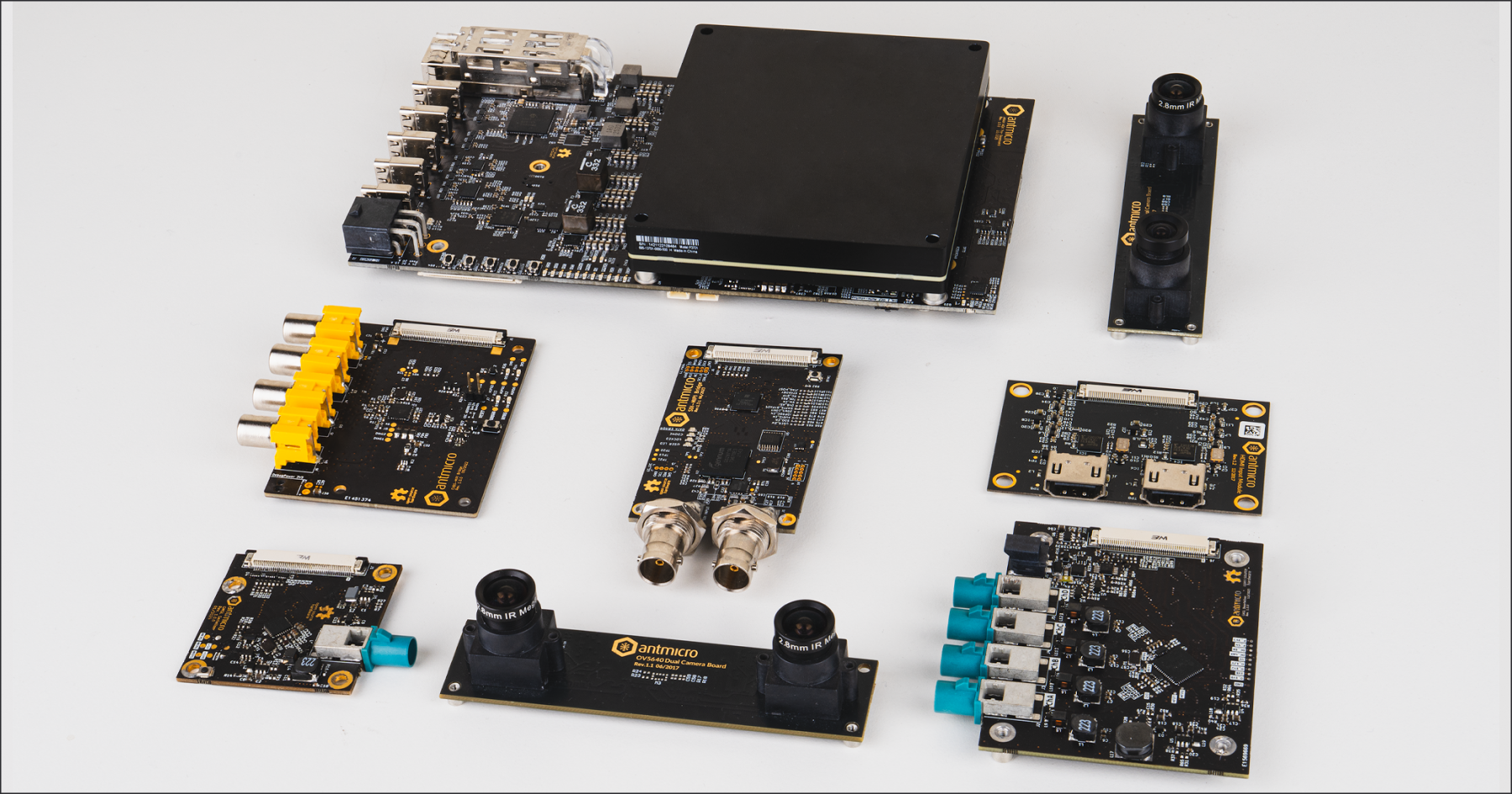
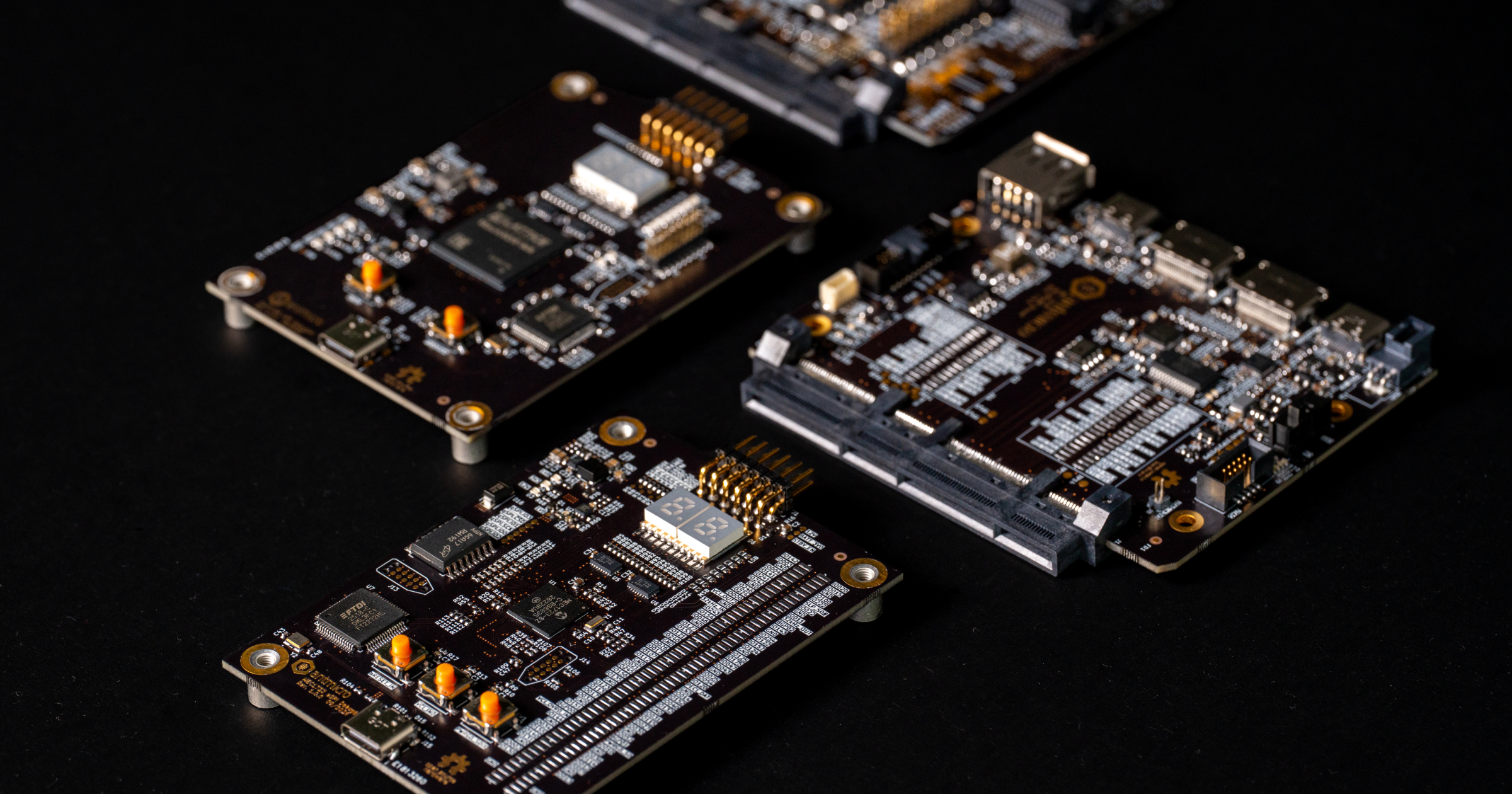
Antmicro’s portfolio of open hardware reference designs includes a variety of accessories and adapters providing fast connectivity options for different use cases. Popular examples include the Thunderbolt to GPU Adapter and the OCuLink to 10 GbE Adapter. To allow for high-speed network connectivity in Thunderbolt-enabled devices such as laptops and workstations, we recently developed a new Thunderbolt to 10GbE Adapter, combining the previous designs into one PCB.
The adapter, while useful on its own as a Network Interface Card (NIC), provides a reference design for a high-speed Ethernet accessory that can be adjusted for particular applications such as smart terminals, Point of Sale systems, smart cameras, IoT gateways and many more. In this blog article we provide a brief overview of the Thunderbolt to 10GbE Adapter and discuss potential customization options.
Thunderbolt to 10GbE Adapter overview
The PCB design of the Thunderbolt to 10GbE Adapter is kept within a compact-sized rectangular outline of 70 x 110 mm (2.76 x 4.33 inch). All the interface connectors (two regular RJ45 ports, one Thunderbolt port) are located along the same, shorter edge of the board to simplify cable management. The board includes fastening holes for passive cooling aperture and for fixing it inside an enclosure. For power delivery, the adapter accepts either USB-C or DC power via a Molex Nano-Fit locking wire-to-board connector.
From the electrical standpoint, the Thunderbolt to 10GbE Adapter combines the Intel EZX710AT2 10GbE controller and the Intel JHL6340SLLSQ Thunderbolt Gen 3 IO controller. Those two controllers have already been implemented and validated in several projects done by Antmicro, and eventually published as open hardware reference designs for the OCuLink to 10GbE Adapter and the Thunderbolt to GPU Adapter respectively. The presented Thunderbolt to 10GbE Adapter design brings those two controllers on a single PCB wrapped in a slick mechanical outline.
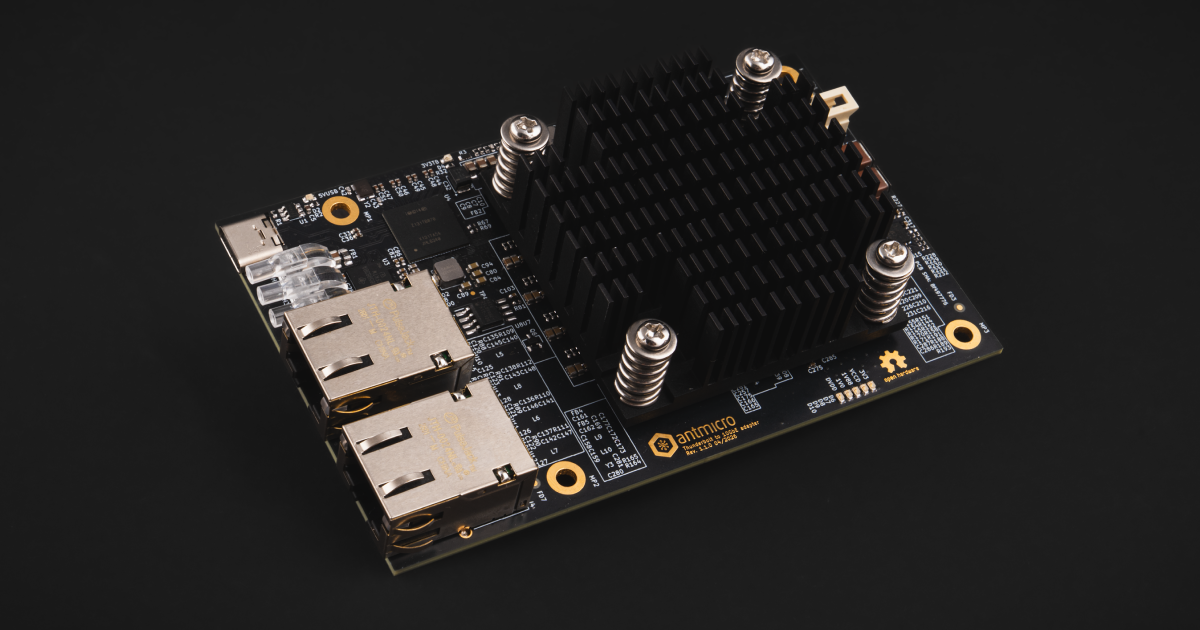
To verify the adapter’s capabilities, we tested it for data throughput and power consumption. When tested with an embedded PC type Thunderbolt host, the adapter achieved 9.4 Gbps of transfer in duplex mode on a single Ethernet channel, and 2 x 5.5 Gbps when both channels transferred data simultaneously in duplex mode. The power consumption stayed under 9 W at all times. This makes the adapter well suited for embedded applications and passive cooling; in our case we used the ATS-61500R-C2-R0 heatsink which stabilized at 65 °C (149 °F) in room temperature ambience.
You can learn more about the Thunderbolt to 10GbE Adapter by visiting our System Designer and Open Hardware portals where you’ll find additional assets such as interactive 3D renders, component lists, BOMs, and more.
High-speed connectivity via Thunderbolt
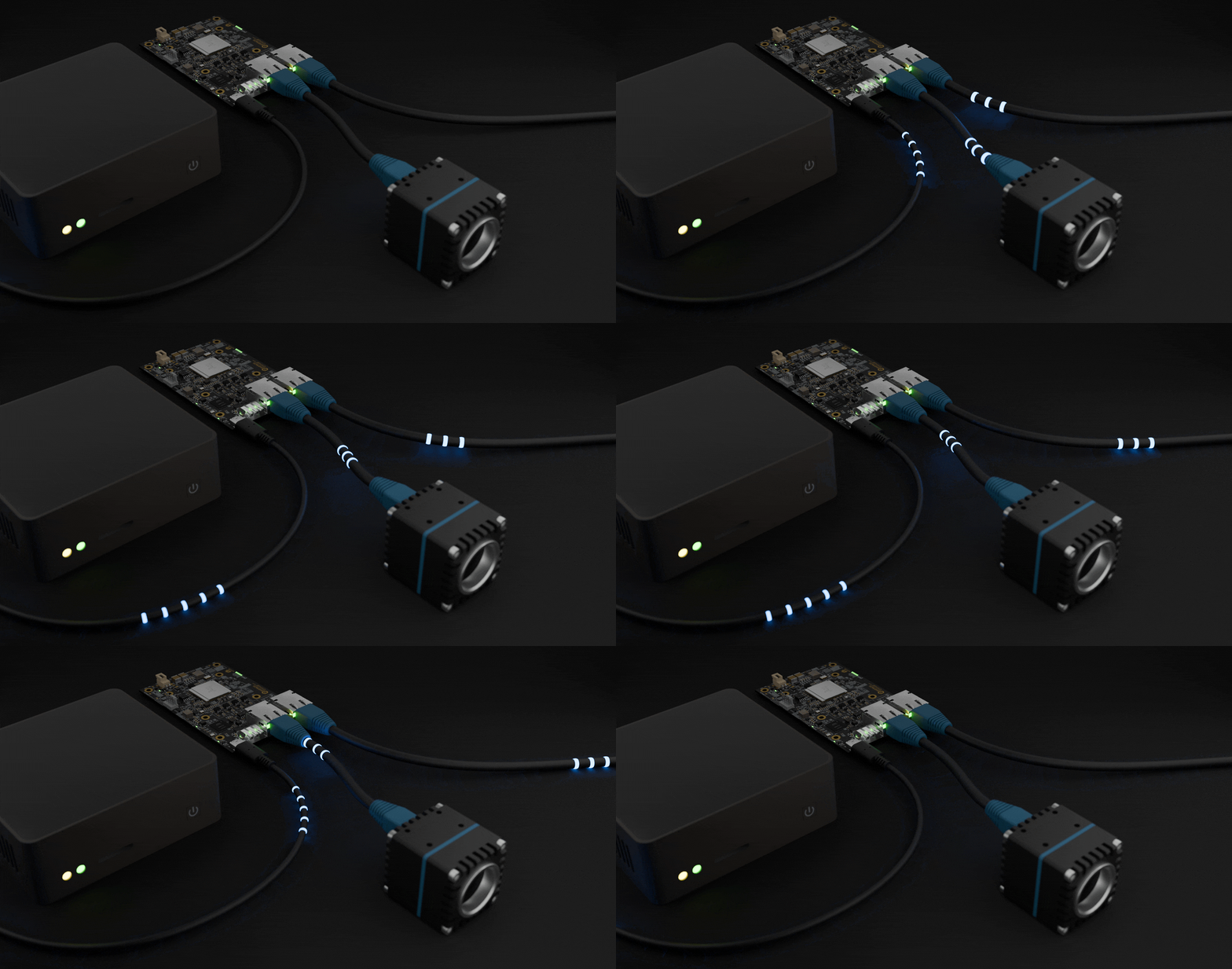
The Thunderbolt to 10GbE Adapter offers two independent networking interfaces tunneled via Thunderbolt and enumerated on the host side, so it is possible to use one interface for local, high-bandwidth Ethernet communication with the attached device, and expose the second Ethernet interface to the Wide Area Network for instance - all with one host and one Thunderbolt interface in between.
The versatile Thunderbolt 3.0 interface provides a throughput of up to 40 Gb/s over medium distances and allows you to daisy-chain up to six devices to a host. As the ubiquitous USB-C connector is the most common standard used by Thunderbolt devices, the Thunderbolt to 10GbE Adapter enables plug-and-play connection bringing 10GbE to a wide variety of devices, from personal computers to embedded systems.
Fully customizable accessories for bandwidth-intensive tasks
Similar to how the Thunderbolt to 10GbE Adapter itself was created by combining two of our previous open hardware designs, it can be easily customized in terms of mechanical arrangement, IO connectors or power supply options. While the adapter is small by design and therefore fit for space-constrained applications, it can be optimized even further to match our customers’ specific use cases.
If you’re interested in building and integrating custom devices which use Thunderbolt and high-speed connectivity, or would like to learn more about how your next high-end computing device project can benefit from our open source-driven hardware development process, reach out at contact@antmicro.com.