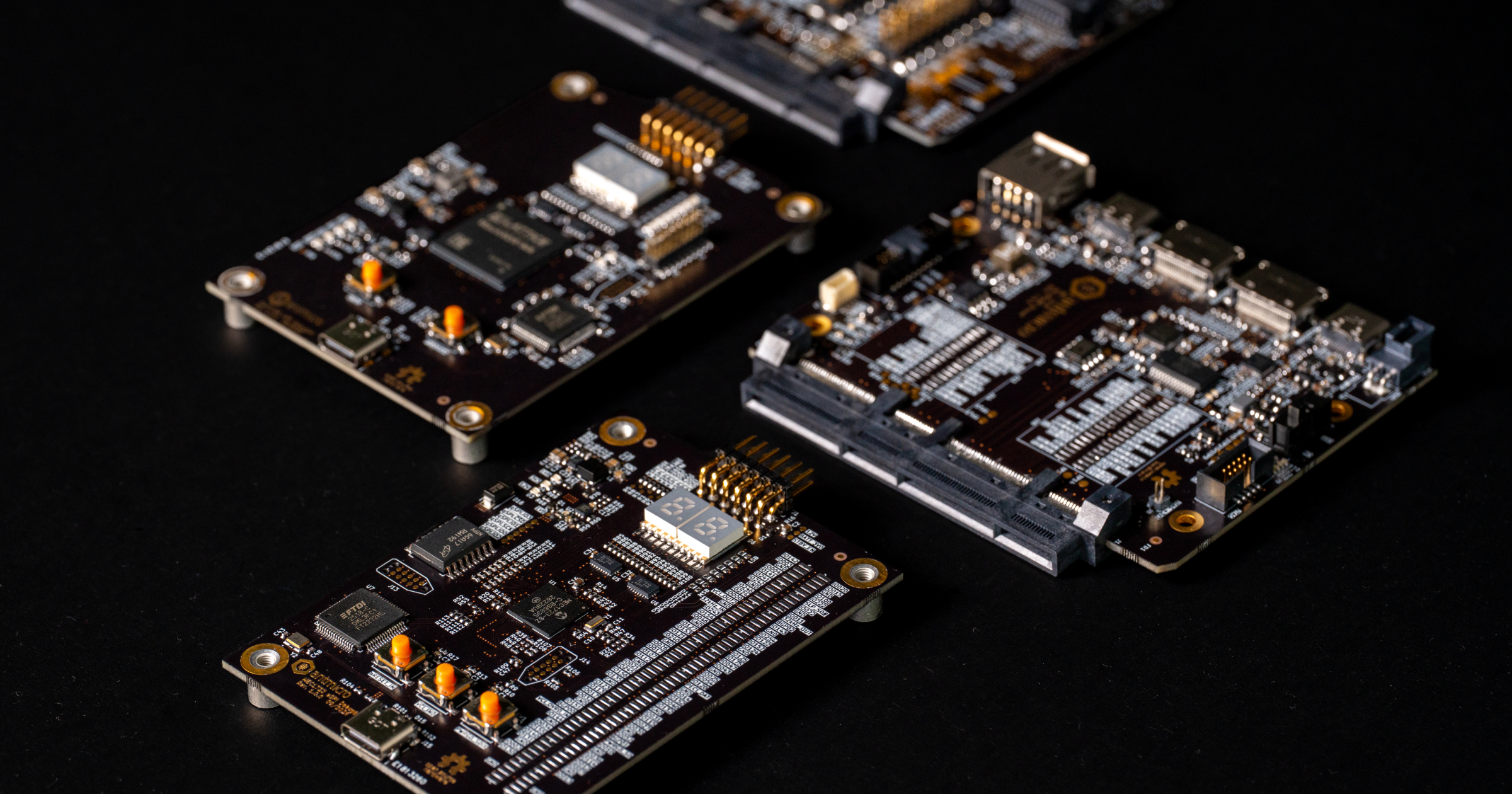
As a long standing NVIDIA Jetson Ecosystem Partner, Antmicro is excited to join this year’s NVIDIA GTC Berlin on October 20-22. With extensive expertise in building custom hardware and software solutions around the NVIDIA Jetson platform, we’ve been designing specialized open source boards and accessories that help streamline the development of complex products for our customers; our advanced open source tools, such as Yocto/OpenEmbedded BSPs, Protoplaster for factory testing, Remote Device Fleet Manager (RDFM) for smart Over-The-Air updates, and the Kenning AI framework have been instrumental in developing, testing, managing, and optimizing Jetson-based devices for edge AI and physical robotics.
If you’re attending GTC, we welcome you to meet us at booth 7036 in the Exhibit Hall of STATION-Berlin: we will be showcasing the breadth of our open hardware baseboards and vertically integrated toolkit portfolio with interactive demos around the NVIDIA Jetson AGX Thor and NVIDIA Jetson AGX Orin platforms, illustrating use cases of how we employ our open source approach to accelerate time-to-market for customers building high-end products harnessing the power of NVIDIA Jetson technologies.
Demo 1: Antmicro’s open hardware baseboard for NVIDIA Jetson AGX Thor running parallel AI models optimized with Kenning
Meeting us at NVIDIA GTC, you will be able to see two technology demonstrations featuring our Jetson-based products: parallel AI models running on the Antmicro Baseboard for NVIDIA Jetson AGX Thor, and RDFM fleet management for a satellite fleet of super computers based on the NVIDIA Jetson Orin platform.
The first demo shows what our open hardware Baseboard for NVIDIA Jetson AGX Thor can do as a foundation for advanced edge AI and robotic products. The baseboard, set in a ruggedized, CNC-milled enclosure fit for industrial scenarios, runs a ROS 2 system that takes video from an integrated, open hardware CSI camera module, and passes it through multiple computer vision models and algorithms at the same time, all optimized and deployed with Kenning, Antmicro’s open source AI framework.
The camera observes a set of selected objects within the booth. A live preview shows the same scene through the eyes of different models side by side: instance segmentation, depth estimation and more. New for GTC, the setup also uses the NVIDIA Cosmos family of multimodal models to analyze the scene and in terms of instance segmentation, depth estimation, object tracking and interpreting hand gestures. Under the hood, each model runs as its own ROS 2 node, and NVIDIA’s Multi-Process Service lets them share the Thor’s Blackwell GPU concurrently rather than taking turns. The approach builds on our multi-model benchmarking work on Jetson AGX Thor with Kenning, whose demo is open source on GitHub.
Alongside the demo, we will display a range of our open hardware expansion boards and accessories that work with our baseboards to build custom vision and data processing systems, including for demanding industrial use cases.
Demo 2: Open source RDFM fleet management and OTA update system for an NVIDIA Jetson Orin-based space computer
The second demo shows how Jetson-based devices are kept up to date and under control once they leave the lab. It combines Antmicro’s open source Remote Device Fleet Manager (RDFM) with our open hardware Baseboard for NVIDIA Jetson Orin, running a setup derived from a real customer’s space computer.
RDFM is a flexible framework for modular, configurable, multi-OS OTA updates and fleet management. Customers use it to manage edge AI devices developed with Antmicro that now operate in agriculture, industry, space and other demanding settings. Its features include:
- Delta updates, and granular updates of individual components such as AI models or configuration files.
- Streamed A/B updates for NVIDIA BSPs with automatic rollback if the new system fails to boot.
- Permission levels, telemetry, and remote shell and actions on connected devices.
- A customizable Web frontend for managing devices, packages and groups.
At the booth, the RDFM interface manages a physical NVIDIA Jetson device, placed in a 4-U Cube Satellite chassis, together with several virtual devices simulated in [Renode]https://antmicro.com/platforms/renode/) that together form a fleet of satellites. We will walk through the update process and different update flows, fleet management and remote actions, and the finer-grained control you can exercise over a single connected device. We will also cover features aimed at devices with restricted connectivity, such as small satellites.
The demo is based on the work we did with Aethero on its NxN and NxA space computers, built on customized versions of our open hardware Jetson baseboards. The next-gen NxA-ECM uses the NVIDIA Jetson AGX Orin for up to 550 TOPS in a dual-SoM setup, and up to 4000 TOPS with two NVIDIA Jetson AGX Thor SoMs, opening the way for complex AI-accelerated processing directly on board, in orbit.
From prototype to fleet: full-stack product development for NVIDIA Jetson
Both demos are small slices of what we do every day for customers: take a Jetson-based idea through hardware design, software, AI deployment and in-field management, using open hardware and open source tools that the customer fully owns.
Open hardware baseboards
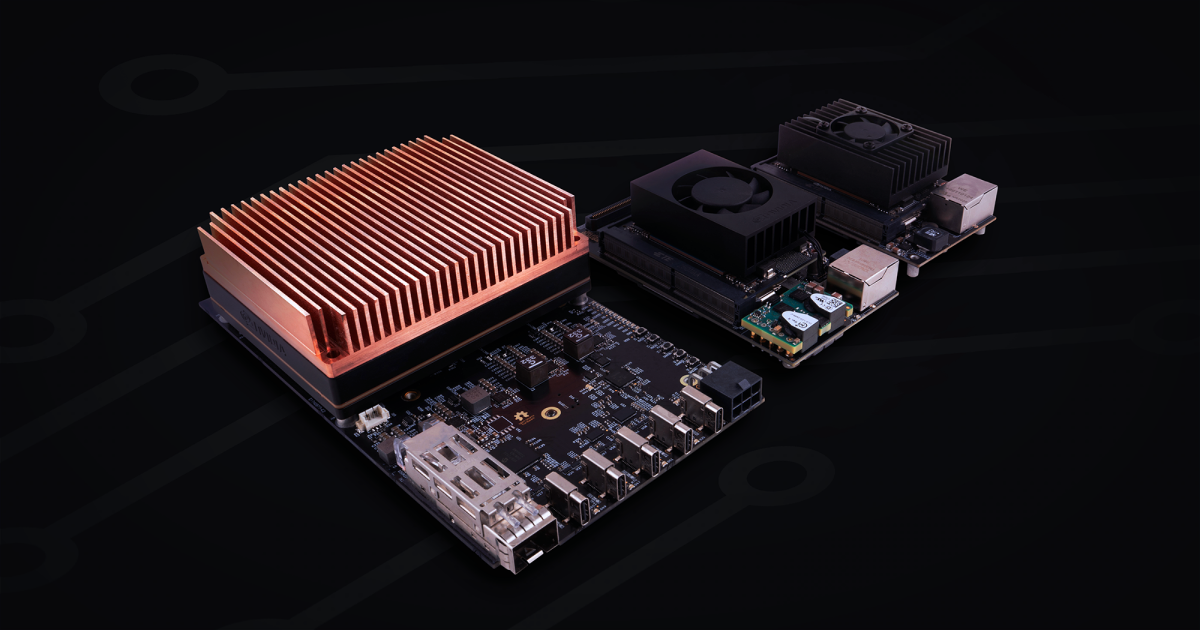
Our open hardware NVIDIA Jetson baseboards are production-ready starting points that we routinely customize into bespoke products, from industrial robots to space computers:
- Antmicro Baseboard for NVIDIA Jetson AGX Thor - a heavy-duty compute foundation for advanced autonomous systems, perfect for advanced vision systems, robots, autonomous vehicles and many more.
- Antmicro Baseboard for NVIDIA Jetson Orin - a flexible, high-performance platform for edge AI solutions for devices that need an adaptable foundation. Supports both Orin Nano and Orin NX.
- Antmicro Baseboard for NVIDIA Jetson Nano - a compact, reliable solution for rapid industrial productization, great for size-constrained fleet-wide rollouts.
The designs are fully open source and you can explore them on Antmicro’s Open Hardware Portal. The NVIDIA Jetson Orin baseboard is available for purchase directly from Antmicro.
Every design is backed by our automated KiCad-Blender rendering flow, thermal simulation and bottleneck analysis, CFD-based active cooling simulation, and in-circuit testing.
Furthermore, we are extending our baseboards, BSPs and tools to NVIDIA’s newly announced modules, so customers can start development or plan migration now. This includes the Blackwell-powered NVIDIA Jetson Thor T3000 and T2000 modules along with the new NVIDIA Jetson Orin Nano 2 SoM, which are scheduled for release next year.
Open hardware accessories for vision and data processing
A growing library of open hardware bridges and adapters lets you connect almost any sensor or video source to a Jetson, all browsable as ready setups in our verks.ai Designer portal:
- Dual GMSL setup for Jetson AGX Thor for multi-camera perception.
- HDMI to CSI, CVBS to MIPI and SDI to MIPI bridges for modern, legacy analog and broadcast video.
- OCuLink to PCIe and OCuLink to 10GbE adapters for storage, acceleration and high-speed networking.
Open source software toolkit
On the software side, we build and maintain the complete stack with open source tools:
- Yocto-based BSPs: reproducible Yocto/OpenEmbedded BSPs and drivers for custom Jetson hardware via our meta-antmicro layer, aligned with support for NVIDIA’s Yocto Project on Jetson.
- Protoplaster: our open source framework for automated hardware, BSP and factory testing, including in-circuit tests.
- Kenning: benchmarking, optimization and deployment of AI models across runtimes, with ROS 2 integration, as shown in Demo 1.
- RDFM: OTA updates, telemetry and fleet management across Linux, Android and Zephyr, as shown in Demo 2.
On top of this toolkit we build CUDA-accelerated computer vision pipelines with GStreamer and DeepStream, and distributed ROS 2 systems spanning many devices.
Join us at NVIDIA GTC in Berlin
Whether you are prototyping your first Jetson-based device, looking to migrate an existing product to the new, upcoming SoM versions of NVIDIA Jetson Thor or NVIDIA Jetson Orin Nano 2, or perhaps looking to manage a fleet of edge AI devices in the field, our team will be happy to talk. Visit us at booth 7036 at STATION-Berlin on October 20-22 to see the demos live, discuss ideas for customization of our open hardware in person, and discover how Antmicro can help you design, build, test and deploy your next Jetson product.
Book a meeting with our team at GTC or write to us at contact@antmicro.com. You can also explore our full Jetson offering at antmicro.com/nvidia-jetson.