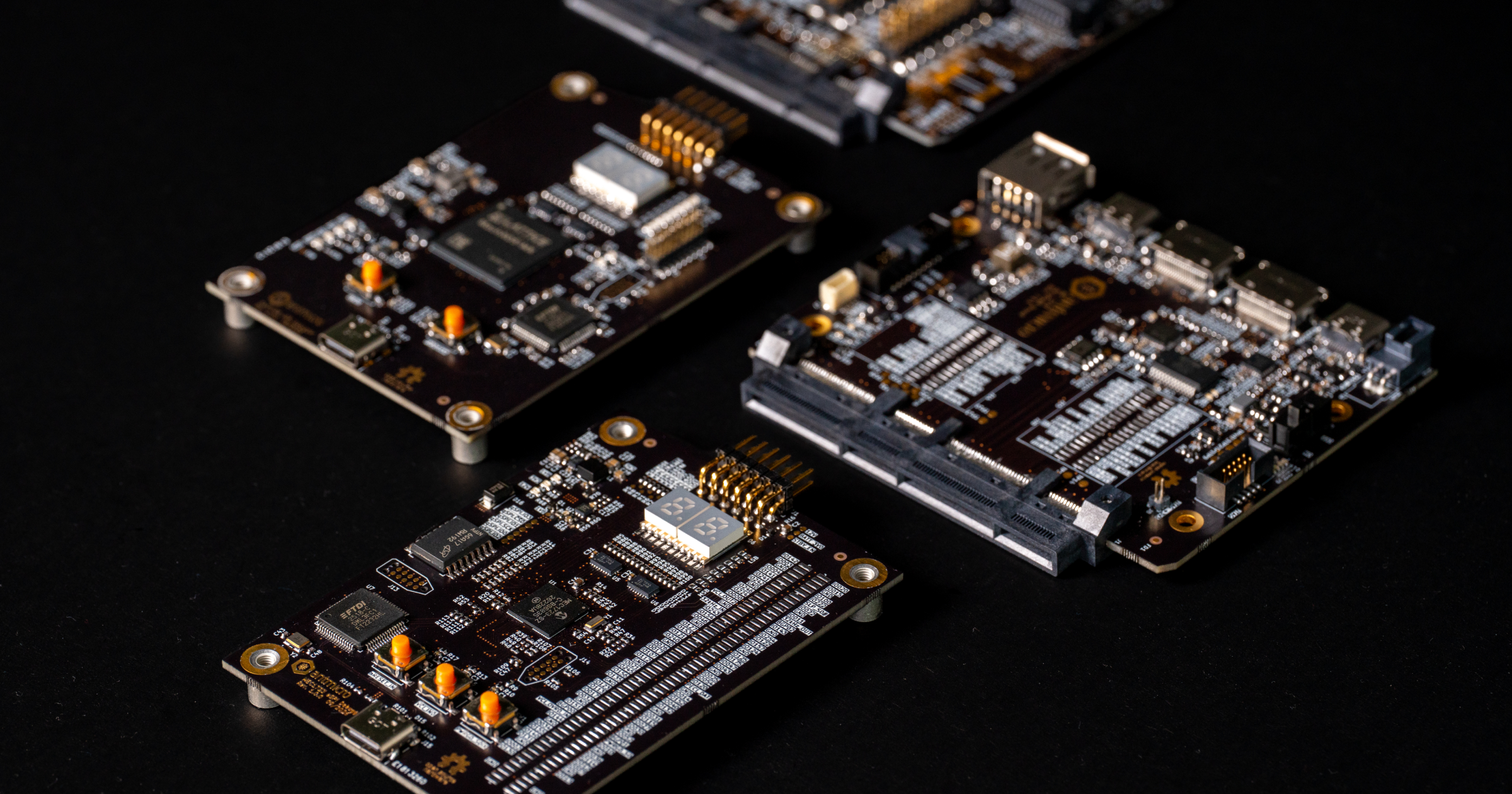
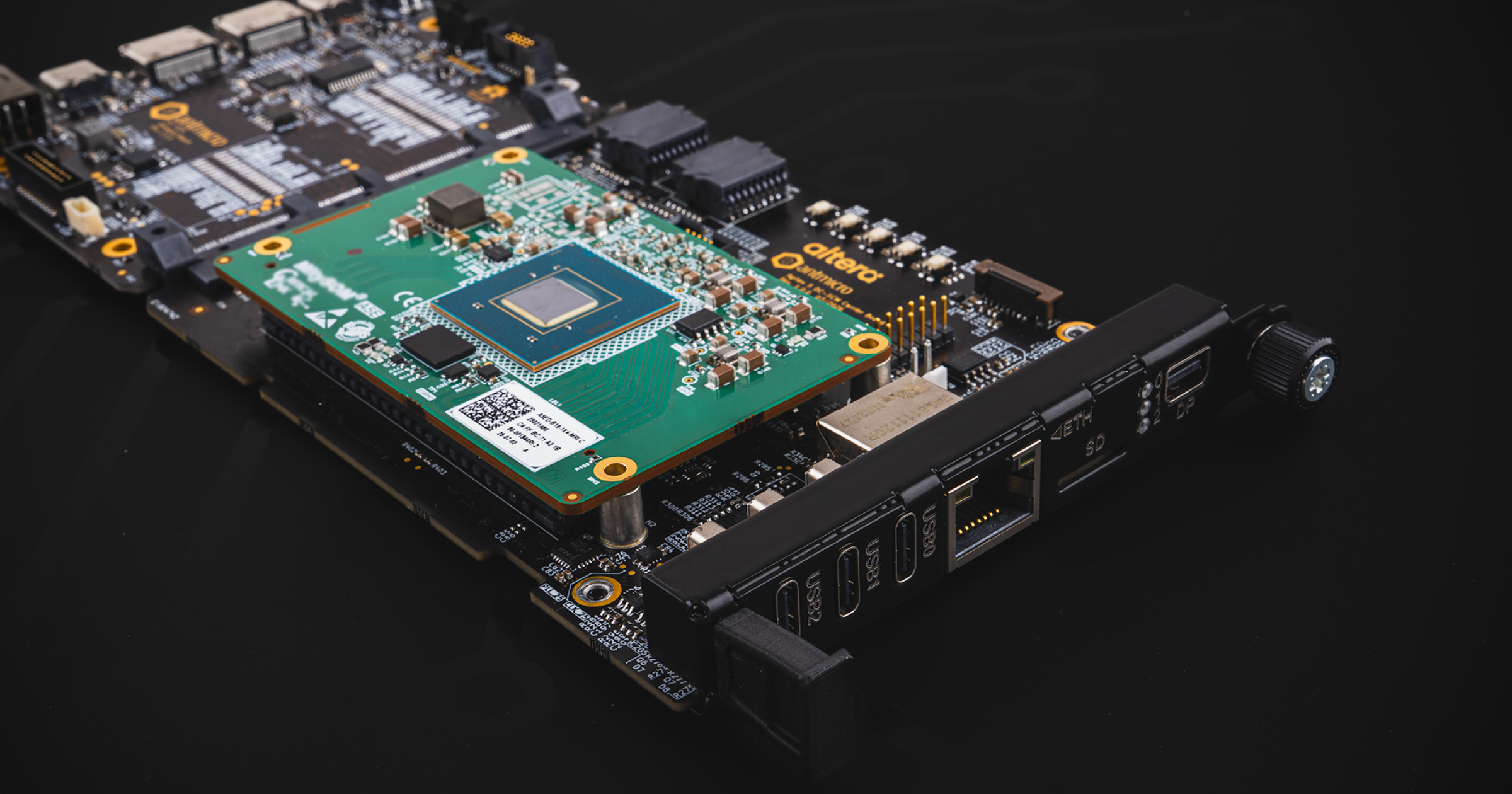
The open hardware Antmicro Baseboard for NVIDIA Jetson AGX Thor provides numerous features enabling fast development of advanced edge AI and robotic products. The NVIDIA Jetson AGX Thor SoM allows connecting up to 6 cameras through its 16x-lane MIPI CSI-2 interface; to take full advantage of the SoM’s capabilities, when designing our baseboard, we included two camera expansion ports with standardized Antmicro 50-pin flat cable interfaces, each exposing two 4-lane CSI interfaces operating at 2.5Gb/s per lane. Each CSI port can be configured via an independent I2C bus, and supports up to 4 virtual channels, making it possible to employ the baseboard in complex multi-camera applications.
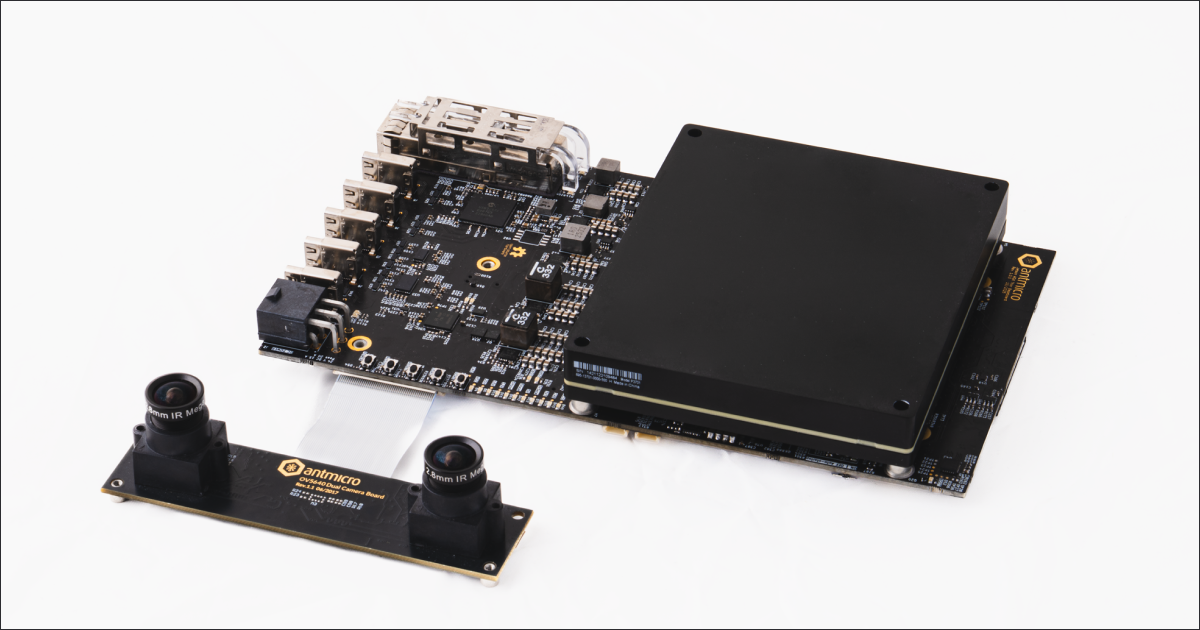
In this article, we describe a setup consisting of the Antmicro open hardware baseboard for NVIDIA Jetson AGX Thor with an OV5640 dual camera board connected over CSI, and show how the board and the wide range of open hardware expansion designs and tools developed by Antmicro provide a perfect starting point for prototyping and building complete high-speed machine vision systems based on the NVIDIA Jetson family of platforms.
Fully customizable Antmicro Baseboard for NVIDIA Jetson AGX Thor
The open hardware Antmicro Baseboard for NVIDIA Jetson AGX Thor was designed to utilize all the capabilities offered by the powerful NVIDIA Jetson Thor T5000 SoM. The baseboard break-routes common I/O interfaces for the SoM and features two 50-pin FFC connectors that make it electrically compatible with a variety of camera modules and video accessories developed by Antmicro, such as the GMSL Deserializer Board or the SDI to MIPI CSI-2 Converter. With a compact outline of just 100 x 180 mm (3.93 x 7.08 inch), the baseboard is especially suitable for embedded products, and can be used even in demanding environments thanks to its accompanying ruggedized enclosure for industrial applications, complemented by custom, CFD-based cooling solutions with blower fans that enforce air flow through its longer axis.
With the recent announcement of the new range of more compact and cost-efficient NVIDIA Jetson Thor T2000 and T3000 SoMs, Antmicro is already offering assistance with full-stack product development around the NVIDIA Jetson SoM that will best fit your particular use case, as well as with migrating existing solutions to the new modules. Since the baseboard itself and all related accessories developed by Antmicro are fully open source, they can be easily customized in terms of size, layout and available I/Os. For more detailed information about the baseboard, with a list of components, interactive 3D renders, downloadable assets and more, visit Antmicro’s Open Hardware Portal.
On the software side, as an official NVIDIA Jetson Ecosystem Partner, Antmicro supports customers with tailored Yocto-based Linux BSPs for a wide range of edge AI applications, using our meta-antmicro Yocto layer as a starting point for developing BSPs custom-made for specific use cases. Antmicro also provides a portfolio of open source tools that together facilitate end-to-end development, testing, deployment, and management of products built on any member of the NVIDIA Jetson ecosystem. These include the Remote Device Fleet Manager (RDFM) and the Protoplaster automated testing framework.
CSI connectivity for multi-camera machine vision scenarios
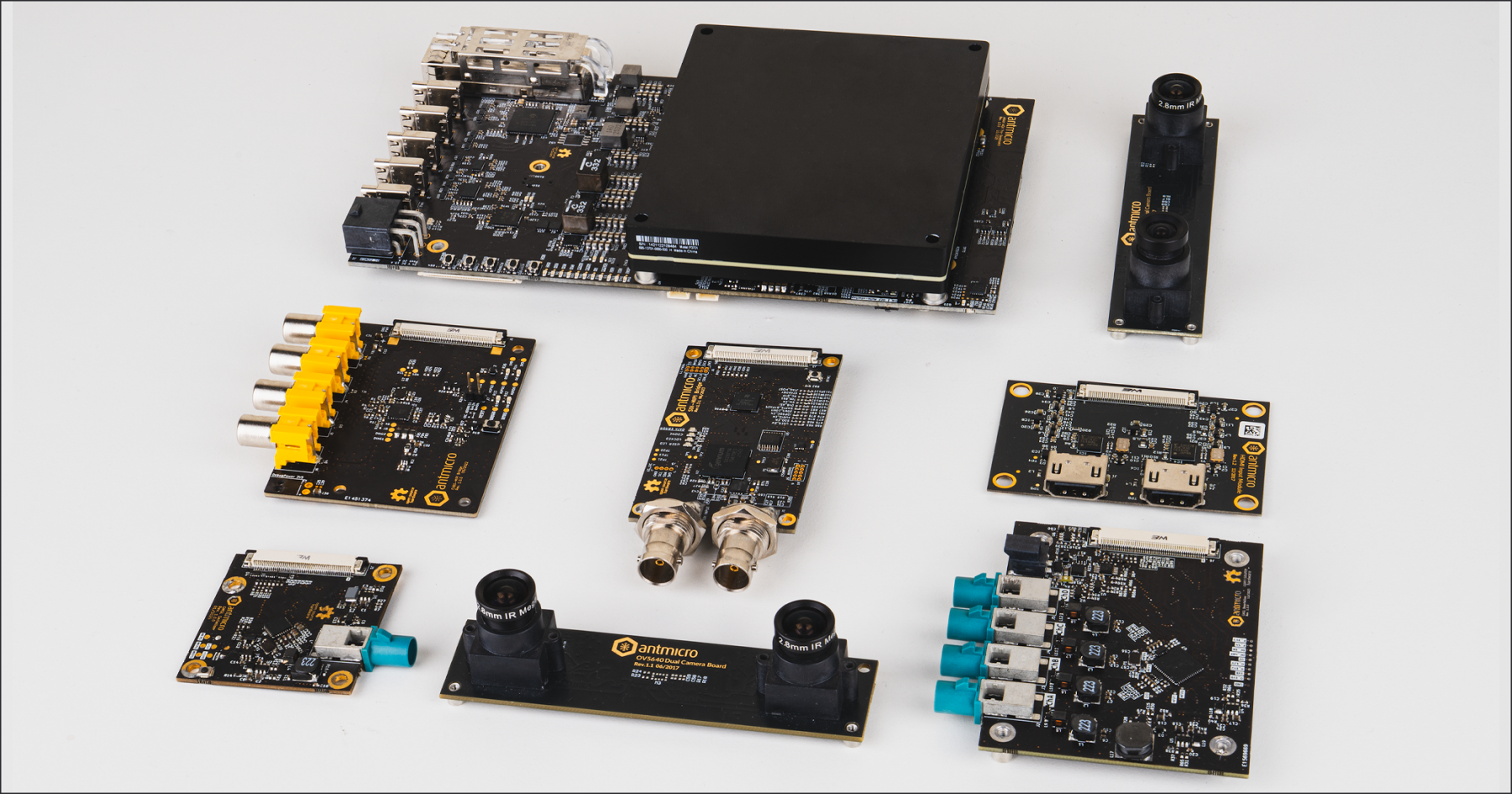
To discover the video capabilities of our open hardware baseboard, consult the dedicated setup in Antmicro’s verks.ai portal that features an OV5640 dual camera board connected to the baseboard over an FFC connector. Serving as an illustrative example, this setup can be further expanded with various compatible video accessories developed by Antmicro to help our customers arrive at complex, multi-camera machine vision systems faster. Those include:
- Dedicated camera adapters
- SDI-MIPI Converters with optional long-range fiber optic extenders
- CVBS-MIPI Converter
- HDMI-MIPI Converter
- GMSL Serializers and four-channel Deserializer
All of these hardware configurations can be combined with Antmicro’s collection of custom ROS 2 nodes running on the SoM to process video input from the CSI cameras, which is then passed through multiple computer vision models and algorithms for a live preview of the scene with different data collected by the models. For benchmarking, optimizing and deploying multiple AI models on NVIDIA Jetson AGX Thor and other Jetson SoMs, Antmicro employs its versatile Kenning AI library that supports a wide range of frameworks and runtimes, allowing you to generate detailed reports for easy evaluation of ML models, runtimes, and target hardware across deployments. See how our baseboard and Kenning allowed us to test the Gemma 4 family of models released by Google earlier this year, and visit us at GTC Berlin this year to explore the possibilities enabled by this approach for advanced machine vision in physical AI and robotics with the NVIDIA Cosmos omni-model.
Discover Antmicro’s open hardware and open source toolkit at NVIDIA GTC Berlin 2026
To see the setup described in this blog note and other examples of Antmicro’s product development services for the NVIDIA Jetson ecosystem, meet us on October 20-22 at NVIDIA GTC Berlin at booth 7036. On top of the open hardware Baseboard for NVIDIA Jetson AGX Thor running parallel AI models optimized with Kenning, we’ll be demonstrating the aforementioned open source RDFM fleet management and OTA update system for an NVIDIA Jetson Orin-based space computer - read more in our sneak peek Antmicro at GTC Berlin 2026 article.
Got an idea for your next NVIDIA Jetson-based device? Learn more about our engineering services, visit antmicro.com/nvidia-jetson/ and reach out at contact@antmicro.com.