Google’s Coral NPU is an open source, RISC-V-based ML accelerator designed for ultra-low-power, always-on edge AI applications. Developed in a HW-SW co-design paradigm, the Coral NPU offers efficient, native ML acceleration for wearables, IoT devices, mobile phones and more.
With the aim to set a fully open source industry standard for edge AI acceleration (from RTL to ML toolchain), the Google Research team behind Coral NPU has been collaborating with Antmicro in the past around the Open Se Cura project that laid the foundations for the current Coral NPU effort. Now, Antmicro has once again partnered with Google to support and extend the emerging Coral NPU ecosystem, offering assistance in embedding the Coral NPU RTL in customers’ SoC designs, as well as extending the related compiler toolchain, simulation and other tools. Those include Renode, Antmicro’s flagship open source simulation framework, which helps customers streamline product development in various applications, including RISC-V-based ML accelerators.
In this article we present how the Coral NPU can serve as an accelerator for SoCs, using the high-performance, ML-enabled NXP i.MX 8M platform simulated in Renode as an example. We’ll also briefly describe how our continuous efforts on supporting UVM for the Verilator RTL simulator have made it possible to run the UVM-based Coral NPU DV under Verilator, allowing for complete co-simulation of Coral NPU SoCs with Renode.
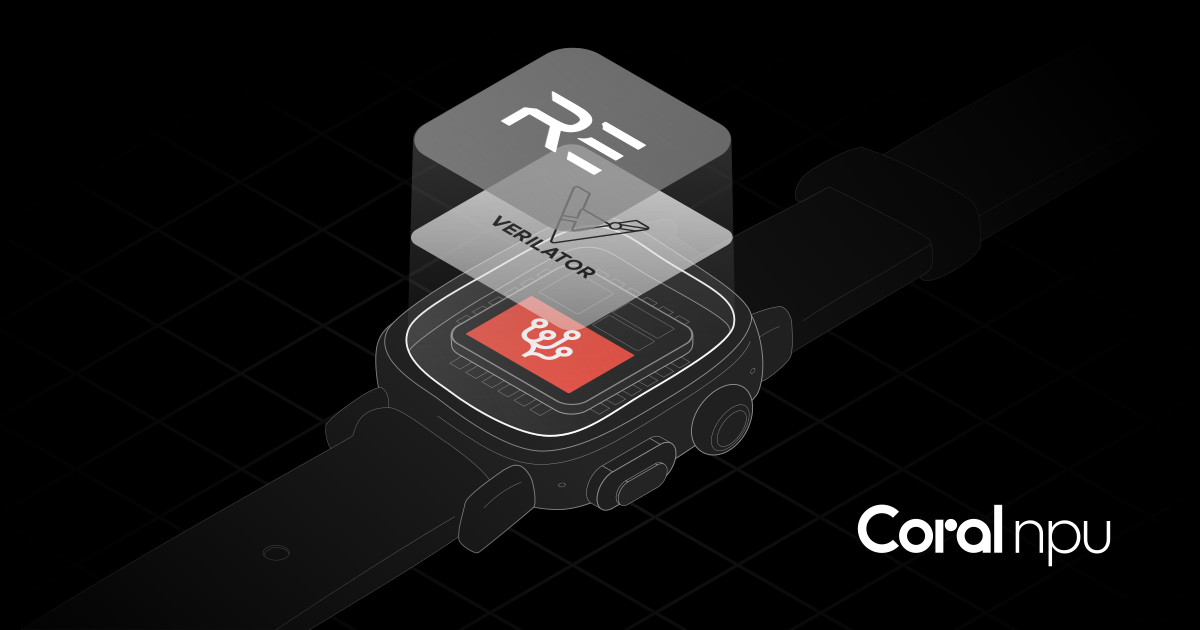
Renode support for Coral NPU
Coral NPU is based on the 32-bit RISC-V Instruction Set Architecture (ISA). At the time of writing, it’s on milestone 3 of the platform roadmap, and includes a scalar core and a RISC-V vector (RVV) execution engine, with a matrix execution unit underway. The current version of the Coral core is fully supported in Renode.
Antmicro’s goal is to enable prototyping of Coral-enabled platforms and, with the right software (such as our Kenning AI optimization and deployment framework), to verify how our customers’ applications would behave with a Coral NPU accelerator. To that end, on the Renode side, we’ve prepared a simple CoralNPU component which can be added into any existing platform and used out of the box:
npu: CPU.CoralNPU @ sysbus 0x20000This self-contained block simulates the Coral core with its embedded memories, and can be controlled interactively from Renode Monitor just like any CPU. It also comes with memory-mapped CSRs and an address space that can be interacted with to program the payload and control the execution from the main platform’s CPU.
Running Linux on NXP i.MX 8M Plus with Coral NPU in Renode
Having Coral NPU accelerate an embedded SoC such as the NXP i.MX 8M Plus serves as a good demonstration of what chip makers and teams evaluating new platforms for edge AI devices can achieve with simulation-driven software development in Renode. While i.MX 8M Plus, with four Cortex-A53 and a Cortex-M7 core, is a capable SoC on its own, Renode flexibility enables us to prepare an artificial scenario exploring various architectural choices when designing new solutions.
To showcase this setup, our demo runs Linux on the NXP i.MX 8M Plus with the Coral NPU inserted. We have also included a Robot framework script to test the integration.
The target binary used in this demo is based on the rvv_add_intrinsic.cc example from the official Coral NPU repository, which performs array additions via RISC-V Vector intrinsics.
The demo comes with two sample applications - one running this algorithm under Linux, using just the Cortex-A53 cores, and one triggering the calculation on the NPU.
Once the NPU block is added to the platform, a target binary can be loaded into the core either via the Renode Monitor or directly from the guest operating system. Execution is triggered by writing to the memory-mapped CSRs. When the payload finishes running, the resulting data is stored in the Coral’s data memory, which is also mapped to the system’s address space.
Because Renode provides full visibility into the system, we have added custom logic that prints out the amount of instructions executed by each core in the system, showing how the Coral NPU can offload computation-heavy tasks from the otherwise occupied main core.
Coral NPU design verification with Verilator
As a member of CHIPS Alliance, an organization running under the Linux Foundation, we develop and improve digital design verification and developer productivity tools, especially within the SV Tools Project aimed at enabling open source development of SystemVerilog/UVM codebases.
Google, who are currently leading CHIPS Alliance and have been working with Antmicro in various contexts towards enabling open silicon design, in a recent presentation given at RISC-V Summit Europe 2026 discussed a CoralNPU case study, showing how the MPACT ecosystem was used to support instruction set simulation and RTL verification through integration with a UVM testbench. The talk mentioned Renode’s advanced co-simulation capabilities in that context and its existing integration with MPACT.
Coral NPU uses Verilator for cycle-accurate simulation, which is driven by the cocotb framework. However, on its own, cycle-accurate simulation is not enough for UVM-compliant verification. For a while now, Antmicro has been gradually working towards full UVM support in Verilator, introducing features such as dynamic scheduling that are necessary to run UVM-based tests.
Thanks to these efforts, we can now run the UVM-based Coral NPU DV under Verilator. Our flow for running Coral NPU DV with Verilator is already upstream, extending the existing scripts for running DV in other simulators. We’re currently working on adding a Bazel-based testing workflow using UVM in Coral NPU, which we’ll describe in more detail along with other improvements in a dedicated article.
Accelerate Coral NPU-enabled SoC development with Antmicro
As a Coral NPU partner, Antmicro helps customers harness the capabilities offered by the core, providing not only tools such as Renode, but also engineering services for adopting Coral NPU and developing MLIR compilers that can be used with our Kenning ML optimization and deployment framework.
If you would like us to help you integrate the Coral NPU into your next SoC design, or want to learn more about our related services, reach out at contact@antmicro.com.