Originally published on Analog Devices’ Developer Portal on 17th August 2026
Empowering Customers to Develop, Test, and Validate Software Before Hardware Availability
Bottom line: ADI is leveraging Antmicro’s Renode as an open-source simulation environment that complements our SystemC Virtual Platform strategy, enabling customers to develop and test software earlier for Arm-based ADI embedded products before hardware is available.
Moving Software Development Left
As embedded systems become increasingly software-defined, the ability to develop, test, and optimize software before hardware is available is becoming a critical competitive advantage. At Analog Devices, we are expanding our virtual development capabilities by integrating Renode, the open-source simulation framework by Antmicro, into our broader SystemC Virtual Platform strategy, helping customers start software development earlier, reduce project risk, and accelerate time-to-market.
Many modern ADI embedded products rely heavily on Arm-based processing to deliver advanced sensing, signal processing, edge intelligence, and machine learning capabilities. Historically, software development timelines have been constrained by hardware availability, requiring application teams to wait for silicon or evaluation platforms before validating software on representative systems.
ADI is addressing this challenge through a virtual-first development approach. By combining Renode with our SystemC Virtual Platform environment, customers can begin firmware and application development on virtual representations of ADI products before physical hardware is available.
Why Improved Armv8.1-M Support Matters
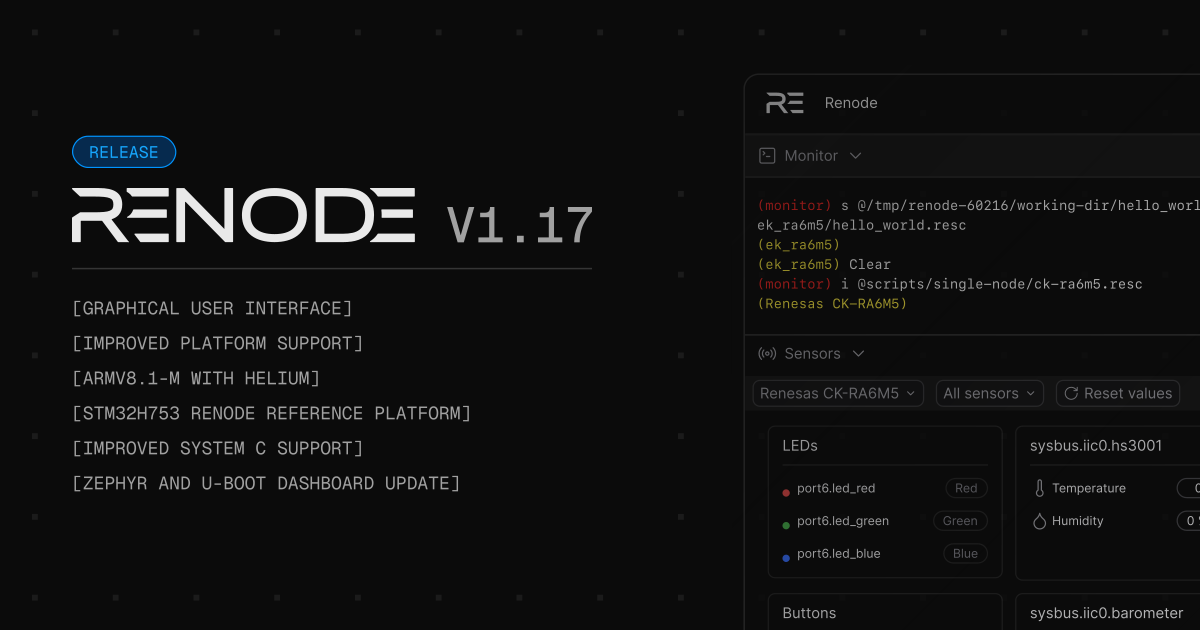
The recent collaboration with Antmicro to improve Armv8.1-M support in Renode is an important step in this strategy. The addition of Helium, also known as the M-Profile Vector Extension, enables Renode to more accurately execute software that depends on vectorized DSP and machine-learning operations.
This matters because many embedded applications increasingly depend on optimized signal-processing and ML workloads. For customers building software around ADI products with Arm Cortex-M processors, accurate simulation of Helium-enabled workloads helps validate algorithm behavior, software correctness, and application readiness earlier in the development cycle.
The expanded support for FPv5 instructions and initial Low Overhead Branch support further extends Renode’s usefulness for modern embedded workloads, improving compatibility with applications that rely on floating point computation and Armv8.1-M architectural features.
Complementing ADI’s SystemC Virtual Platforms
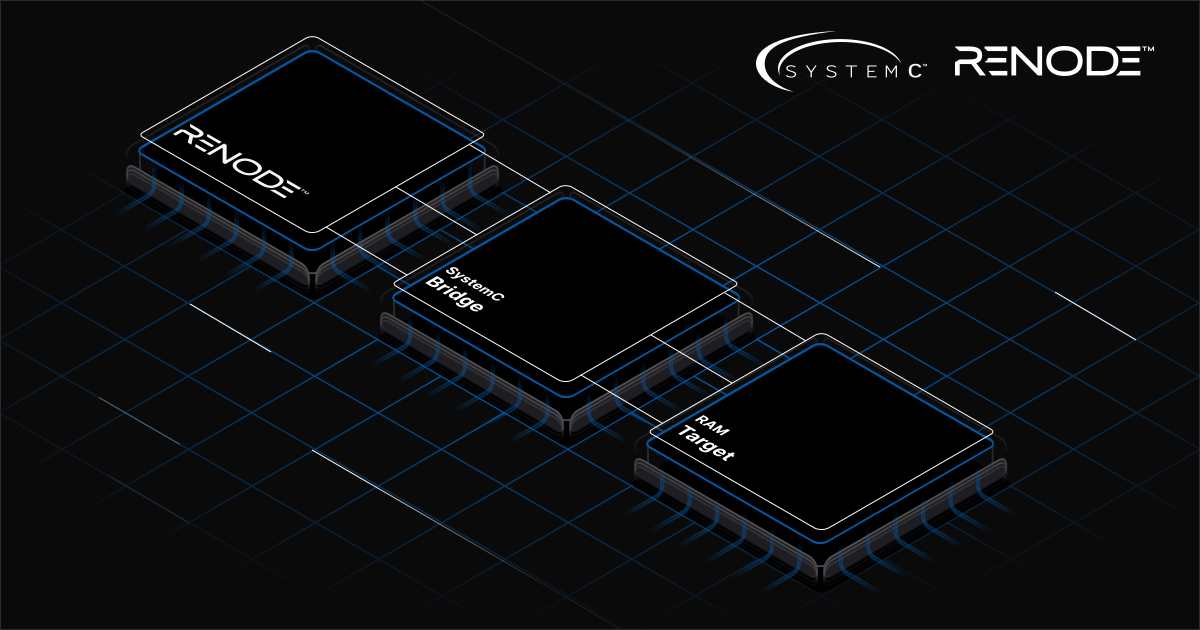
Renode does not replace ADI’s existing virtual platform investments; it is enhancing them. ADI’s SystemC-based virtual platforms provide system-level modeling of ADI devices and subsystems, supporting hardware-software co-development, architecture validation, and early integration.
Renode adds a scalable, deterministic, open-source software execution environment that can be used alongside these SystemC virtual platforms. Together, these technologies provide a practical path for customers to develop, debug, and test software before hardware is available.
| Capability | Role in ADI virtual development flow |
|---|---|
| SystemC Virtual Platforms | Model ADI device and system behavior for hardware software co-development. |
| Renode | Execute embedded software on virtual Arm processors in a deterministic, open-source environment. |
| Integrated workflows | Enable software validation before silicon or evaluation hardware is available. |
| Automated testing | Support CI, regression testing, and repeatable software bring-up. |
Renode: An Open-Source Environment for Customer Development
One of the key benefits of Renode is its open-source model. This is especially valuable for customers and distributed software teams that need to scale simulation across engineers, CI systems, and partner organizations without creating additional commercial simulator licensing barriers.
For ADI customers, this means early application software can be developed and tested in a repeatable environment that is easier to deploy broadly. It also supports automated regression testing, software bring-up, and ecosystem enablement activities long before hardware access becomes widely available.
To help accelerate embedded intelligence development even further, Antmicro offers commercial services for companies across industries such as automotive, space, medical, robotics, to help implement new platforms, sensors and peripherals and integrate Renode into daily workflows with custom tools, integrations, user interfaces, CI infrastructure, and more.
Enabling the Future of Embedded Software Development
Software complexity continues to grow across embedded systems, driven by machine learning, DSP, connectivity, security, and increasing system-level integration. ADI’s work with Antmicro and their open-source Renode simulation framework reflects our commitment to helping customers adopt simulation-driven development workflows that reduce risk and accelerate innovation.
The improvements in Arm support within Renode enable ADI customers to use an open, permissively licensed simulation environment to accurately test early applications on ADI products that rely on Arm processors for compute. Combined with ADI’s broader SystemC Virtual Platform strategy, this gives customers a stronger foundation for developing software earlier, validating faster, and bringing intelligent embedded products to market with greater confidence.
At ADI, we believe virtual platforms and open simulation technologies will play a central role in the future of embedded development. Our work with Antmicro’s Renode is an important step toward making that future available to customers today.