Antmicro’s collection of open hardware designs and technology demonstrators has been recently extended with the STM32H7 HDMI Board. This design combines the popular and powerful STM32H747XIH6 MCU with a set of multimedia interfaces, which makes it a perfect starting point for developing proofs-of-concept and early prototypes of devices that require low-power control features combined with user-facing graphical and audio peripherals.
The STM32H747XIH6 MCU is commonly used in Zephyr-based applications, which significantly extends the range of devices and scenarios where it can be integrated. Complemented by the DSI/HDMI video output introduced in our board, the open hardware STM32H7 HDMI platform becomes a solid base for developing smart devices that require modern GUI and I/O capabilities, such as Zephyr-powered HVAC control panels, coffee machines, vending machines, access control terminals, and more.
In this article, we describe the main features of the open hardware STM32H7 HDMI Board along with potential use cases and application scenarios that Antmicro frequently helps turn into complete products for its customers.

About the STM32H7 HDMI Board
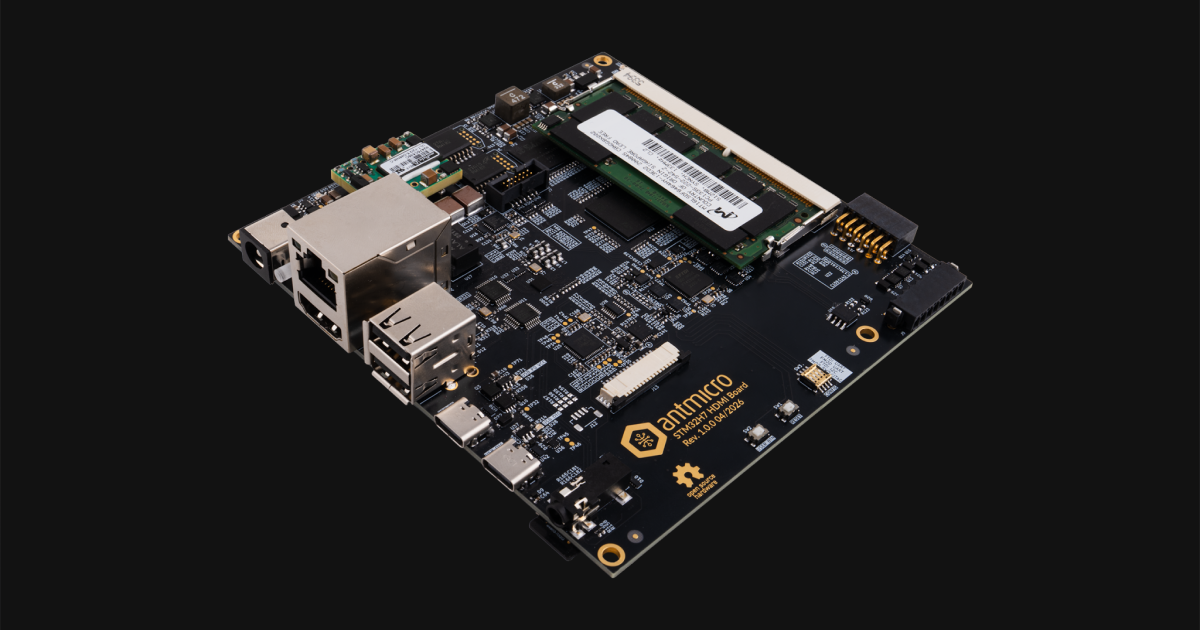
Antmicro’s STM32H7 HDMI Board features the rectangular mechanical outline of a nano-ITX board (120x120mm or 4.72 x 4.72 inches) that is aligned with industry standards for Mini-ITX boards, making it compatible with standardized enclosures. The power supply and I/O connectors are gathered along one edge of the board, which makes it easy to use as a desktop evaluation platform. The design is fully open source - you can explore the board’s components and Hardware Bill of Materials (HBOM) on our System Designer portal.
The center of the board’s design is the STM32H747XIH6 MCU that includes a Cortex-M7 core operating at a top frequency of 480MHz and a Cortex-M4 core operating at a top frequency of 240MHz. The MCU has 2 MB of internal Flash and 1 MB of internal RAM. We have expanded the memory resources available to the MCU by adding an external 4 GB eMMC and a regular SDRAM slot compliant with off-the-shelf memory modules with capacities of up to 256MB. The amount of RAM installed on the board can be further increased up to 512MB by using custom-designed SDRAM modules or converting the on-board RAM slot into a chip-down design. The STM32H7 HDMI Board also includes an on-board SD card slot as yet another storage solution.
The STM32H7 MCU clocking frequency combined with the available amount of RAM and Flash-based local storage already outpaces the hardware configuration of average PCs from the early 2000s, at the same time offering decent power consumption and thermal performance. Additionally, the STM32H7 MCU features a built-in DMA2D mechanism for manipulating graphics and a DSI video output capable of driving displays with a native resolution of up to 480x800 pixels. This makes the STM32H7 HDMI Board a viable platform for developing advanced applications for controlling and maintaining graphical communication with the user.
STM32H7 HDMI Board’s video capabilities
When it comes to video-related features, the DSI video output interface has been exposed on a regular FFC connector which is pin-compatible with a range of DSI embedded displays offered for single-board-computers such as Raspberry Pi. In addition to that, the STM32H7 HDMI Board features a DSI-HDMI protocol converter (ADI/ADV7535BCBZ-RL7), which allows to pass the video output from the STM32H7 HDMI Board to a regular HDMI connector located on the board and use it with a regular HDMI-compliant display. The board’s DSI/HDMI video outputs are complemented with an audio output port driven by the on-board ADI/MAX98091ETM+ audio codec.
The STM32H7 HDMI board already has several I/O interfaces for integrating with external peripherals. Those include 10/100 Mb Ethernet, two independent CAN transceivers, and two USB 2.0 ports with external controllers implemented with the ADI/MAX3421EEHJ+ controller, which is compliant with the HID Boot Support functionality that we have recently added to Zephyr RTOS. There is also a separate USB port that acts as a debug interface and provides access to the system console, allowing to re-flash the MCU with firmware binary.
Thanks to the supported Ethernet and CAN interfaces, the STM32H7 HDMI Board can also be used as a node and/or gateway in numerous networking scenarios. The Ethernet interface is also backed by on-board PoE circuitry so that the whole board can be connected to a local Ethernet network and provided with power with just one Ethernet cable and a PoE-compliant switch.
The interactive diagram below shows all the interfaces available on the board:
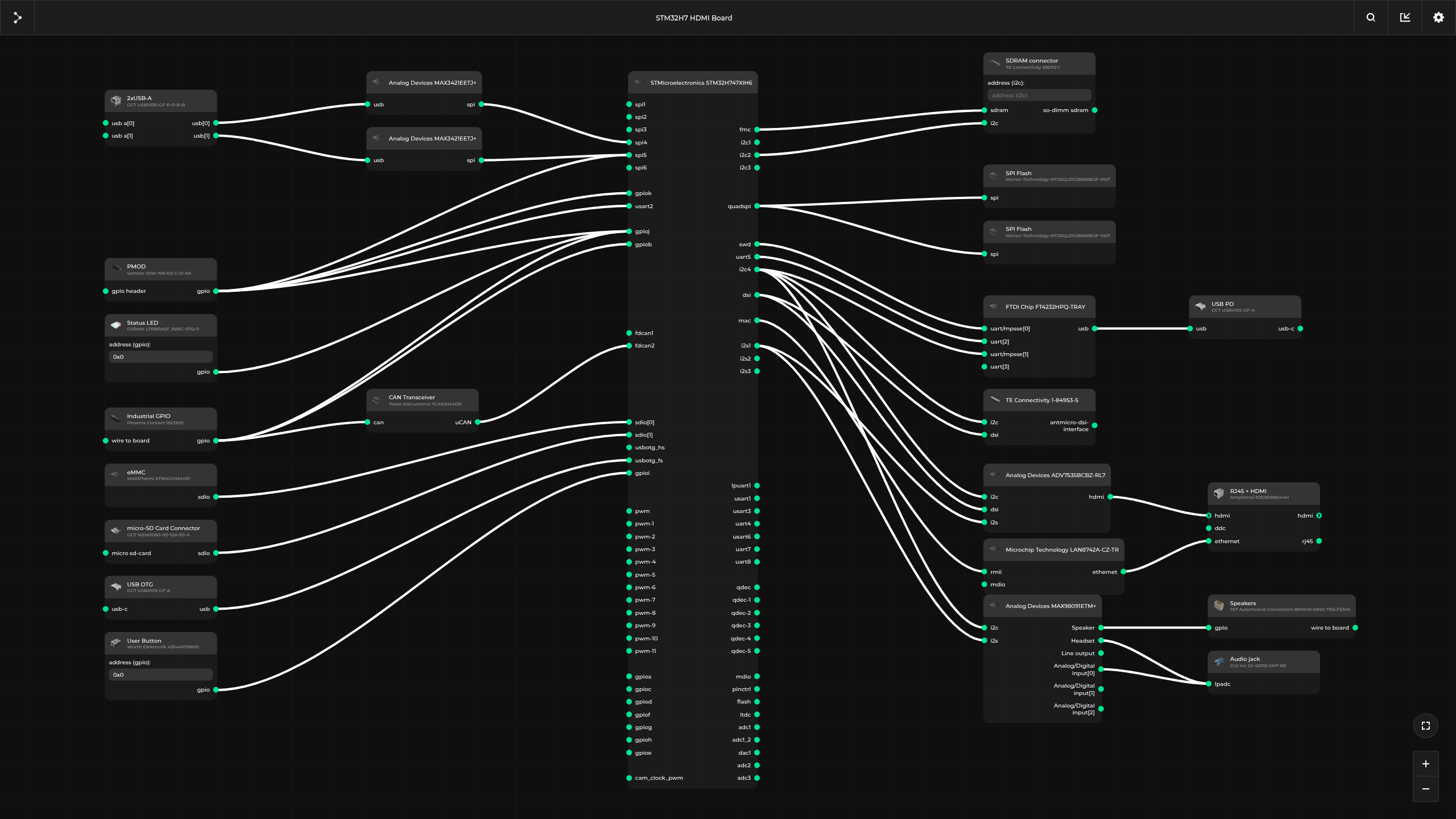 Visit the desktop site to make use of this interactive sandbox.
 The STM32H7 HDMI Board also includes one PMOD-type expansion connector so it is possible to integrate the board with a number of PMOD-compliant accessories such as sensors, actuators, drivers, and many more.
Build early versions of your Zephyr-based products with the STM32H7 HDMI Board
The STM32H7 HDMI Board integrates audio and video outputs with a powerful MCU, decent amount of RAM and storage, and a range of popular IO interfaces. This makes it a perfect development platform for building proofs-of-concept or early prototypes of devices running Zephyr (or other OSes) that combine control, data collection, and connectivity with user-facing UIs.
The implementation of nice-looking user interfaces can be easily streamlined with our open source grvl GUI library, which is ideal for building lightweight interactive interfaces. On top of that, replaceable RAM modules and SD card storage allow to store, load, and display multiple images, animation frames, fonts, backgrounds, icons, and other resources which can then be used for constructing an advanced and aesthetically pleasing looking interfaces in various devices like HVAC control panels, vending machines, room scheduling systems, etc.
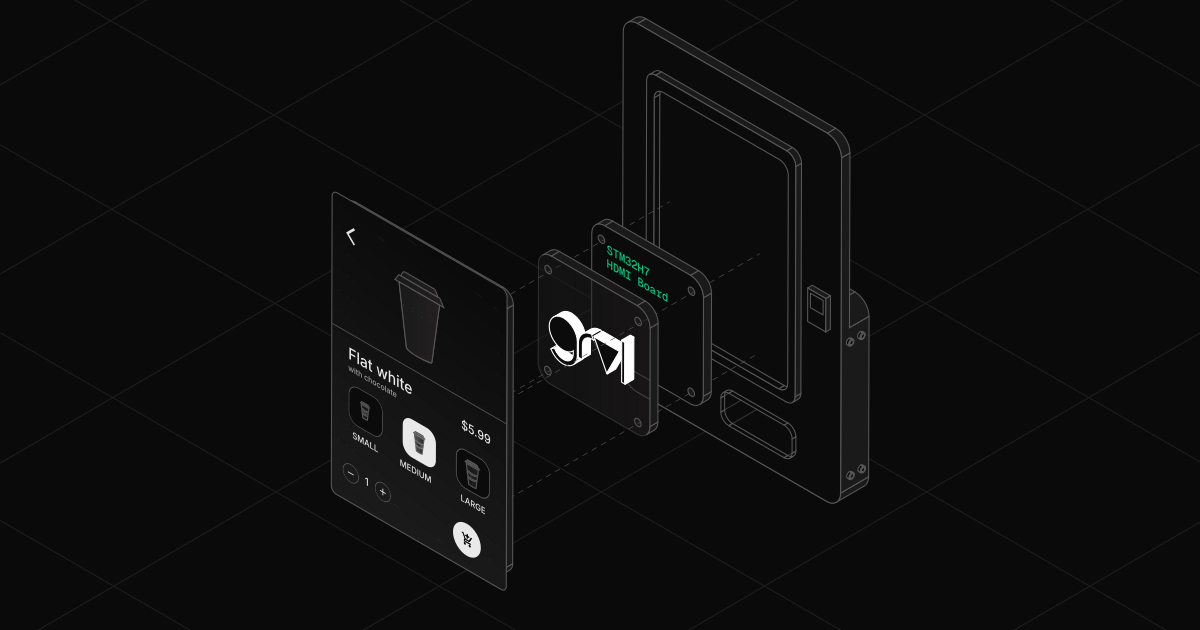
The grvl library also neatly integrates with Zephyr, which we consider to be the primary RTOS that can be run on the STM32H7 HDMI Board. You can read more on how grvl can be used to build GUIs for Zephyr-based MCUs in an article we published some time ago. The Zephyr-based MCU firmware can also be easily expanded with fleet management and remote updates handled by our open source RDFM framework. Read more about the benefits of combining Zephyr with RDFM’s advanced OTA update capabilities in this blog.
Naturally, the board can be easily supported in our open source simulation framework Renode to allow for faster software development alongside the hardware development process.
Bring modern UI, storage, and connectivity to your product
The design of our STM32H7 HDMI Board can be adjusted to your target application in terms of mechanical outline, on-board connectivity and storage, and supported power supply scenarios (including battery-operated and solar-powered applications) to adapt to a variety of advanced setups.
Antmicro can help you bring your product from an early proof-of-concept stage to a complete, customized, and ready-to-use solution through our transparent hardware development process, with the STM32H7 HDMI Board serving as a solid base for early development and prototyping of graphics-oriented devices.
Our commercial offering also includes comprehensive engineering services for building, testing, and customizing products running Zephyr RTOS across a wide range of use cases and industries. If you would like to take advantage of Antmicro’s expertise in building embedded solutions that span from choosing the right hardware to software deployment and simulation-based testing with Renode, write to us at contact@antmicro.com.