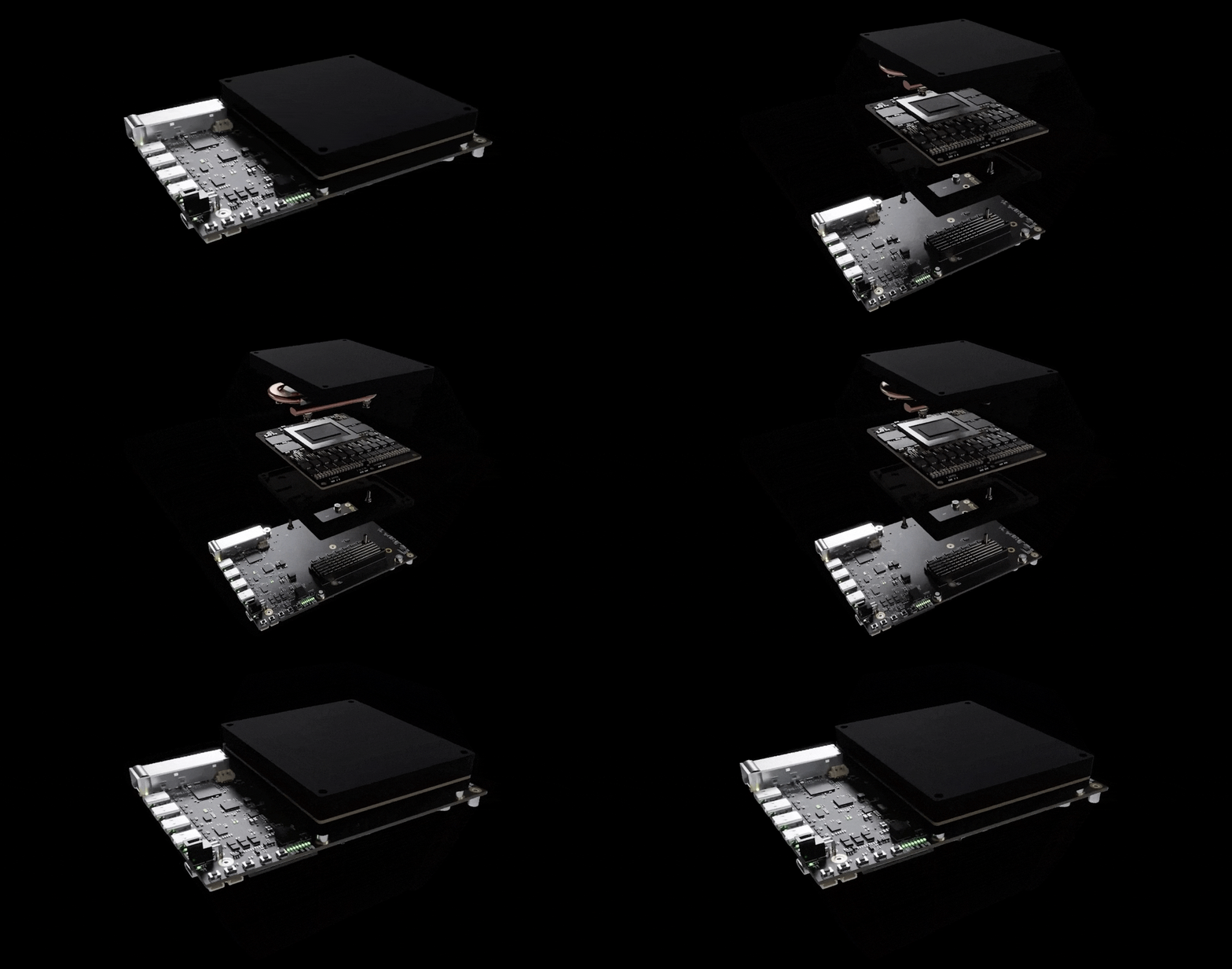
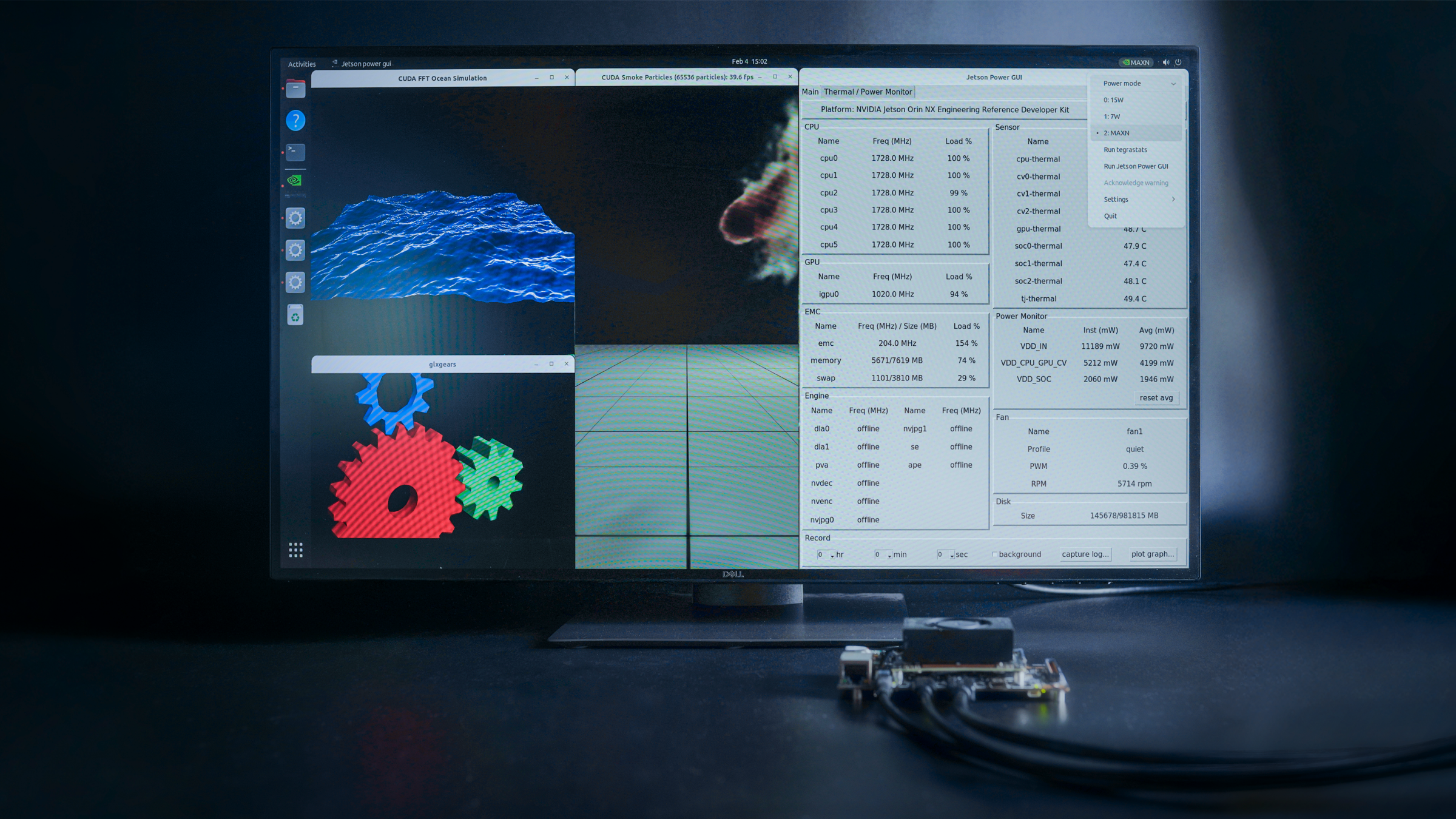
Antmicro today announced support for NVIDIA’s recently announced T2000 and T3000 system-on-modules. With their expected compact and cost-efficient characteristics, the new modules will provide more variability to choose from when building edge AI products and offer an option to migrate from already existing systems to Jetson Thor alternatives more tailored for a given task, depending on the complexity and needed throughput. At half the size of the Jetson Thor T5000, while still utilizing the powerful Blackwell GPU architecture, the new variants are set to make development more accessible, shorten delivery lead time, and lower the barrier to entry for mass-market robotic systems and edge AI applications.
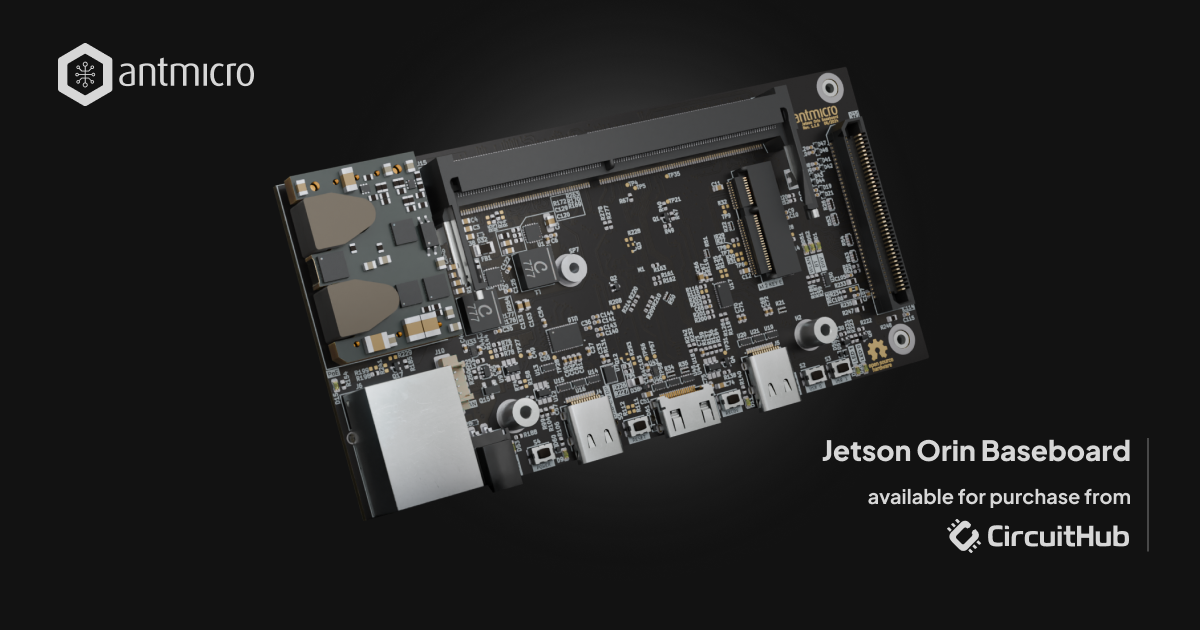
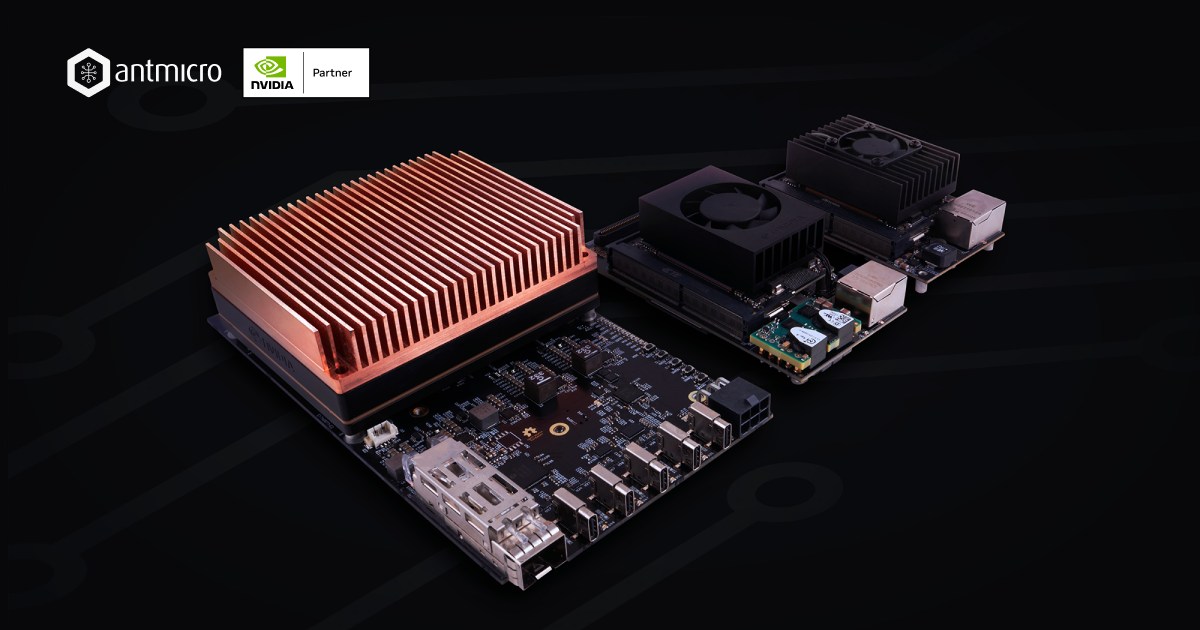
As an official Jetson Ecosystem Partner, and with more than a decade of experience in designing complete products around every SoM from the NVIDIA Jetson series, Antmicro is offers its broad portfolio of end-to-end NVIDIA Jetson engineering services to support the transition of our customers to these new modules. Building on top of our open hardware baseboards for NVIDIA Jetson AGX Thor and NVIDIA Jetson Orin, both of which are frequently customized for projects spanning industrial robotics to in-orbit space computing, Antmicro assists in full-stack product development and migration.
Antmicro’s transparent development methodology is built around our constantly expanded open source workflow, providing customers with full control over the entire stack: from open hardware design and customization coupled with our Yocto-based open source toolkit for creating custom BSPs, advanced computer vision pipelines and distributed ROS 2 systems, through factory testing with Protoplaster and RDFM-based OTA updates and fleet management systems, to tailored AI model optimization and deployment with our open source Kenning framework.
In this blog, we provide an overview of the new NVIDIA Jetson Thor T2000 and T3000 SoMs and explain how Antmicro’s services and open source tooling can help you build your next NVIDIA Jetson product on top of the more optimized, compact, and yet powerful edge AI platform for robotic applications, such as visual AI agents, autonomous mobile robots, and industrial manipulators.
New NVIDIA Jetson Thor T2000 and T3000 SoMs
Expected to become available in Q1 2027, the newly announced modules, T2000 and T3000, are part of the NVIDIA Jetson Thor series - a high-performance range of modules for physical AI/robotics, edge AI scenarios, and advanced autonomous systems. NVIDIA Jetson Thor modules support a wide array of generative AI models, allowing users to utilize Large Language Models (LLMs), Vision Language Models (VLMs), or agentic AI frameworks; an example of which would be Google’s open source Gemma 4 running on Antmicro’s open hardware Baseboard for NVIDIA Jetson Thor. They can also be used in multi-model solutions, allowing to operate on different modalities and solve multiple problems in parallel.
The new modules are aimed at providing a broader range of customers with the latest Jetson Thor architecture while allowing for easier market scalability. They’re both based on Blackwell, NVIDIA’s newest architecture with features such as native FP4 precision support, which allows fitting and efficiently running large models even with smaller memories shipped with the new modules. The T2000 is a new starting point for the NVIDIA Jetson Thor family, with 16GB of memory and delivering 400 FP4 TFLOPS of performance - meant for visual AI agents, autonomous mobile robots, and intelligent machines that may benefit from its more compact size, bringing the Thor architecture to a wider array of edge AI applications. The T3000 is a more powerful variant, providing 32GB of LPDDR5X memory, with 865 FP4 TFLOPS of compute power.
With the addition of these modules, developers have a wider range of choice of performance in NVIDIA edge AI platforms: from the NVIDIA Jetson Orin Nano with 70 TOPS to the NVIDIA Jetson Thor T5000’s 2070 TFLOPS, developers can find a solution for any workload demand. The same applies to module memory - not every application is in need of all of T5000 or T4000’s memory (128GB and 64GB respectively), and now, developers of these applications don’t have to opt for a module with memory they don’t require. With prices of DRAM at an all-time high, this enables scalability to a much higher degree than before, with the NVIDIA Jetson Thor T3000 said to be able to operate at four times less memory than the flagship T5000.
Engineering services based on open source: customized hardware, thermal simulation, Yocto-based BSPs, RDFM OTA update systems, and AI optimization and deployment with Kenning
Antmicro’s Open Hardware Portal presents a range of Jetson-based open hardware designs and technology demonstrators that often serve as the backbone for early proof-of-concepts rapidly developed into complex, production-ready solutions adapted to the specific use cases for customers across aerospace, robotics, automotive, medical, and more.
An excellent example of how our fast-turnaround prototyping process and open source toolkit directly translated to shorter time-to-market is Aethero’s fleet of space computers - the NxN-ECM and the next-gen NxA-ECM, designed to provide edge AI compute as a service on Low-Earth Orbit, built around customized versions of Antmicro’s open hardware baseboards for NVIDIA Jetson Orin and NVIDIA Jetson AGX Thor, with the NxA-ECM capable of harnessing the power of two NVIDIA Jetson AGX Thor SoMs for up to 4000 TOPS.
With the introduction of the new Thor T2000 and T3000 SoMs, Antmicro will be expanding its range of customizable open hardware baseboards for the NVIDIA Jetson family accordingly. Leveraging our transparent open hardware development process, we can help you bring your product to life, from prototype to a production-ready solution, and design custom ruggedized enclosures for applications operating in harsh industrial environments.
Today, customers are invited to use Antmicro’s full-stack product development services to start evaluating and developing solutions around the NVIDIA Jetson platform. Antmicro can help you build and test reproducible Yocto/OpenEmbedd BSPs tailored to your end application and your Jetson-based hardware of choice (including the implementation of drivers and services for handling the device), and also take advantage of our automated thermal simulation and bottleneck analysis flow for better informed decisions throughout the development.
Using our comprehensive software engineering services, you can further extend the capabilities of your Jetson-powered devices with custom OTA-enabled lifecycle management with Antmicro’s open source RDFM framework. You can also easily manage dispatched devices remotely, not only performing the updates but also observing their telemetry and accessing their shell and dedicated actions via a management dashboard in RDFM.
As the newly announced NVIDIA Jetson Thor T2000 and T3000 SoMs make it possible to run serious AI workloads on more power-efficient/lower-memory configurations, our open source Kenning framework becomes instrumental for benchmarking, optimizing and deploying such workloads on target Jetson-based devices, helping you to get the most out of hardware resources while ensuring efficient AI model performance. Find out more about comprehensive tests of several small and large AI models running on the NVIDIA Jetson AGX Thor we performed with Kenning, measuring multiple parameters such as inference time and CPU/GPU usage to verify their optimal execution on Thor-based devices.
Accelerate the development of your NVIDIA Jetson Thor-based physical AI products with Antmicro
At a time of continuously growing memory prices, the NVIDIA Jetson Thor T2000 and T3000 will serve as a cost-efficient alternative to the currently available T4000 and T5000, providing developers with the same powerful architecture while allowing for more cost-effective scaling of edge AI platforms, particularly within the fields of robotics and autonomous machinery.
Find out more about Antmicro’s services around the NVIDIA Jetson platform at antmicro.com/nvidia-jetson/, reach out at contact@antmicro.com, and meet us at this year’s NVIDIA GTC Berlin on October 20-22, where we will be showcasing the capabilities of our open hardware baseboards, edge AI vision demos, example customer projects, and more.