The new 1.17.0 release of Antmicro’s open source Renode simulation framework is here, bringing extended platform support, new features and various fixes and improvements. Since the last release, we’ve been working with customers and partners such as Analog Devices, Google and Aethero, as well as communities gathered around open source projects including the Zephyr RTOS, improving every aspect of Renode. These efforts resulted in Renode’s wider adoption among silicon vendors, embedded systems developers and customers from the automotive and space industries, where it’s used for architectural exploration, hardware/software co-development, scalable testing, and post-silicon system validation.
In this article we summarize the most significant developments introduced with Renode’s 1.17.0 release: support for new platforms including NXP i.MX 8M Plus and Toyota RAMN, improvements to NXP S32K88, a new GUI, improved SystemC support, external control API, and much more.
Improved platform support: Armv8.1-M with Helium, NXP i.MX 8M Plus, Toyota RAMN and Coral NPU
A major improvement introduced with Renode’s 1.17.0 release is the extended Armv8.1-M support with Helium instructions. On top of the optional M-Profile Vector Extension (MVE, also called Helium), we also added support for FPv5 instructions, as well as initial support for the LOB (Low Overhead Branch) extension. Developed in collaboration with Analog Devices, it enables a broader class of applications to be simulated in Renode without any changes to the code.
The 1.17.0 release also brings a wide range of new platforms supported in Renode. The most notable examples include NXP i.MX 8M Plus, Toyota RAMN setup that can be connected to the CARLA simulator, and significant improvements to NXP S32K88. Additionally, we added support for Google’s Coral NPU, a RISC-V-based ML accelerator designed for ultra-low-power, always-on edge AI applications. We introduced a CoralNPU component in Renode which can be added into any existing platform and used out of the box for prototyping of SoCs accelerated with the Coral NPU.
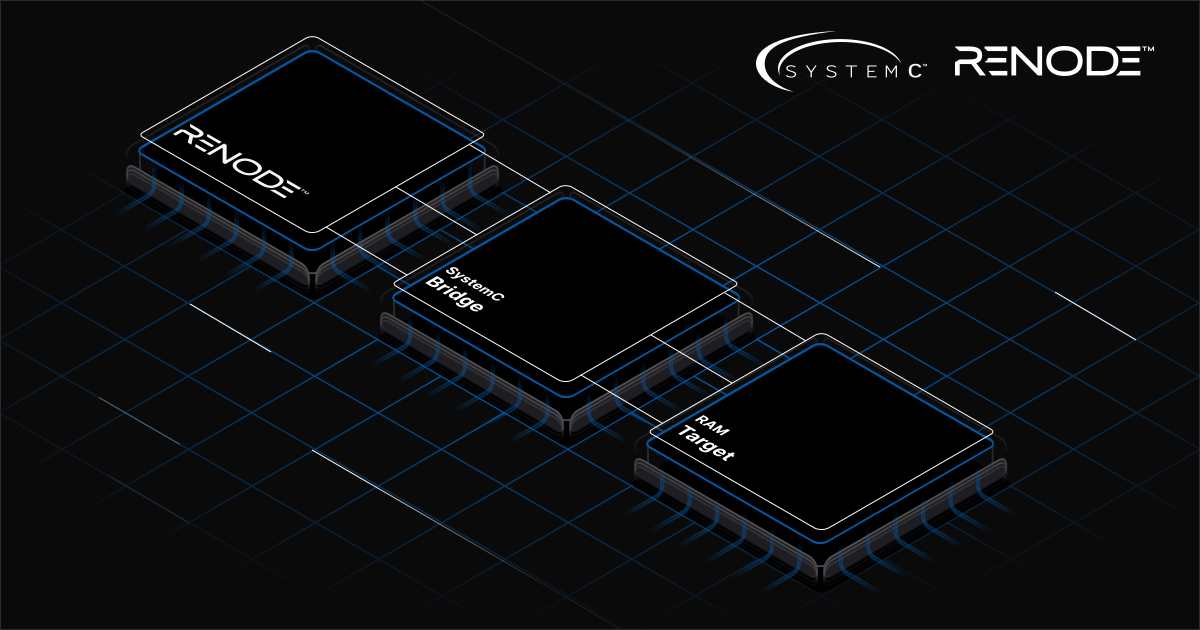
Apart from adding new platforms, we’ve also been working on enabling a broader range of use cases in Renode. To that end, we improved support for the SystemC language and library, including support for Direct Memory Interface (DMI), native connection between SystemC and Renode to reduce the communication overhead, more flexibility in connecting multicore setups, and direct exposure of CPU control signals. We currently provide these features for Arm Cortex-M platforms and we’re working on adding them for RISC-V ones, which we’ll describe in more detail in a separate article.
Renode Reference Platform and improvements to Renode Zephyr and U-Boot dashboards
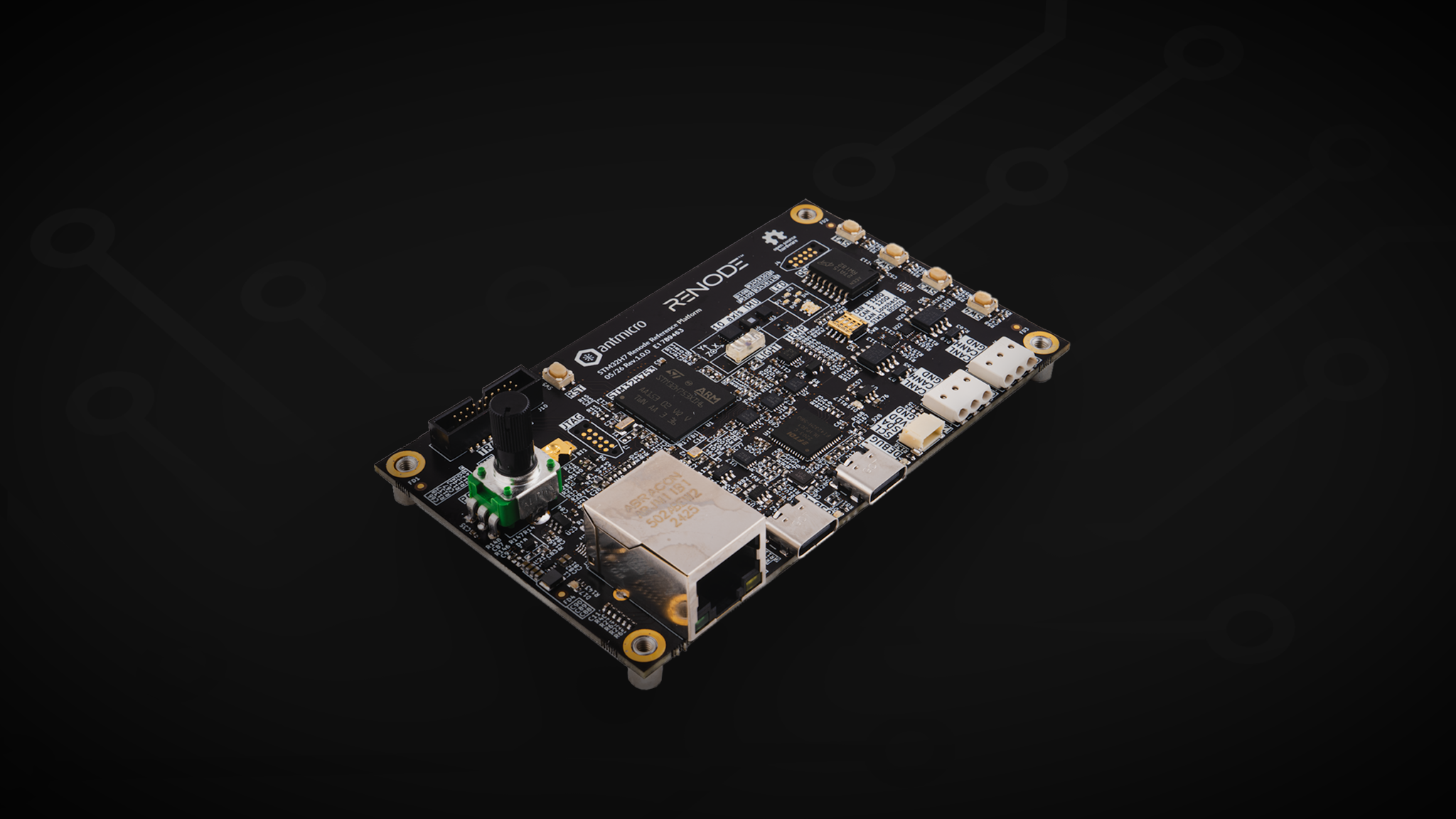
To showcase Renode’s capabilities and allow our customers to easily experiment with Renode, we developed the STM32H753 Renode Reference Platform, a technology demonstrator that’s available both as a physical board with an open source design and its digital twin in Renode. We’re currently working on enabling full testing of the Renode Reference Platform in Zephyr, but it’s already proven useful for showcasing Renode’s many features, including interactive software debugging and multi-node simulation.
Many updates in Renode are driven by changes to the Zephyr RTOS and related tools such as dts2repl. The results of these changes can be seen directly in our Renode Zephyr Dashboard and the analogous Renode U-Boot Dashboard which provide a quick overview of Zephyr- and U-Boot-compatible platforms currently supported in Renode. The dashboards have recently got significant improvements in terms of UI/UX and new features, as described in more detail in a dedicated blog article, and we’ve now passed 1000 platforms in the Zephyr dashboard thanks to the recently introduced support for the Xtensa architecture. Additionally, all the data from the dashboards, including the demos and downloadable assets, is now also available in Antmicro’s System Designer Portal.
New GUI, external control API, migration to dotnet
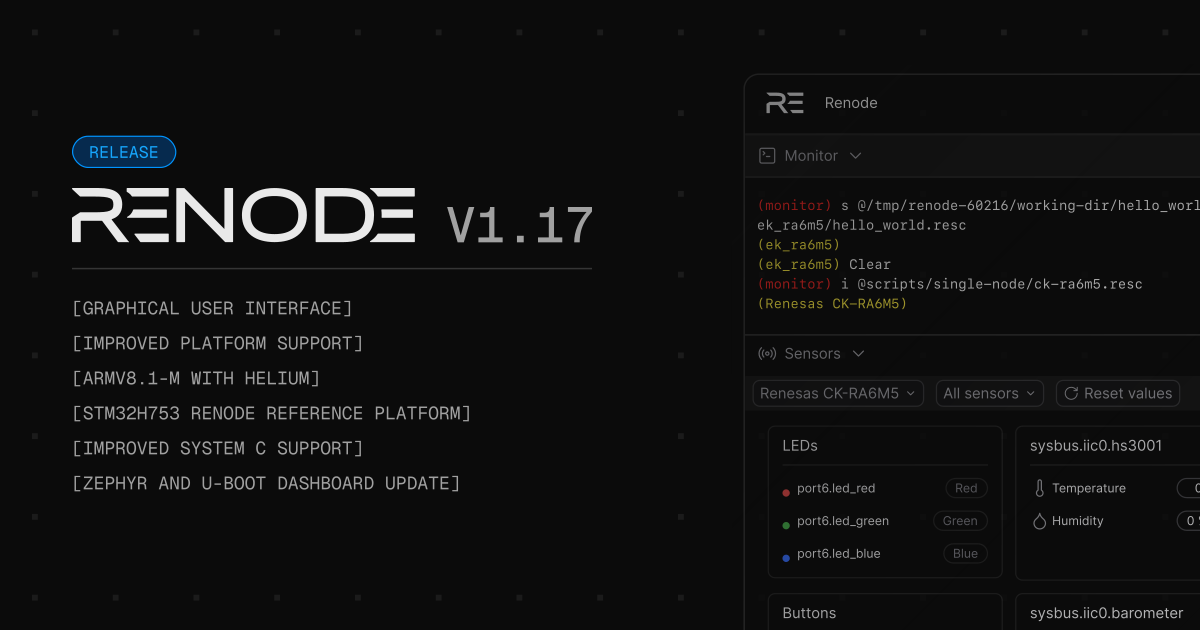
On the UX side, with the 1.17.0 release Renode gained a new GUI that provides multiple features, such as Monitor, Sensors, Renode Logs, and UARTs, in a single, unified view. The GUI can be used locally or inside a browser in System Designer with Renode running in server mode on your machine.
To enable Renode users to interact with the simulation programatically from third-party applications, we reworked our external control API. The API’s C library lets you easily integrate Renode with other tools in various scenarios, e.g. for co-simulation with external peripheral/platform simulators or for hardware-in-the-loop testing. More details about the external control API will be soon described in a separate article.
Another big improvement is the new ADC interface and the related input infrastructure. Prior to Renode 1.17.0, devices producing ADC inputs were not represented in the simulation, and the user had to enter raw voltage values for appropriate channels, which required reading the board schematics and/or the firmware code. Now devices creating ADC inputs, such as potentiometers and voltage dividers, can be represented in Renode with a user-friendly API.
With the new Renode release we fully migrated to dotnet, dropping Mono support in the process. This change was motivated by the performance and code quality improvements offered by dotnet, as well as lower maintenance cost compared to Mono. Since dotnet is portable across different systems and architectures, we used it to introduce a multiplatform Renode package that provides a unified codebase for all users across different environments. With the advent of Arm-based macOS workstations and EOL of X86-64 support, we are no longer publishing macOS packages for Intel machines - however you will still be able to build Renode from source for a period of time.
For a complete list of additions, performance improvements, and fixes, see the 1.17.0 changelog.
Develop, run and test your software with Renode
With the new release, Renode offers even more features for accelerating software development and testing, providing a fully deterministic simulation environment for complex multi-node systems. With support for various architectures including Arm and RISC-V and over 1200 boards, Renode can be used to model your hardware, then develop and run your software before physical devices are available.
Antmicro can help you integrate Renode into your existing workflows, and implement new platforms, peripherals, features and tools. To learn more about Renode’s capabilities, don’t hesitate to contact Antmicro at contact@antmicro.com and visit Renode’s new, fully restructured page for an overview of its features, use cases and integrations.