1200+
boards supported
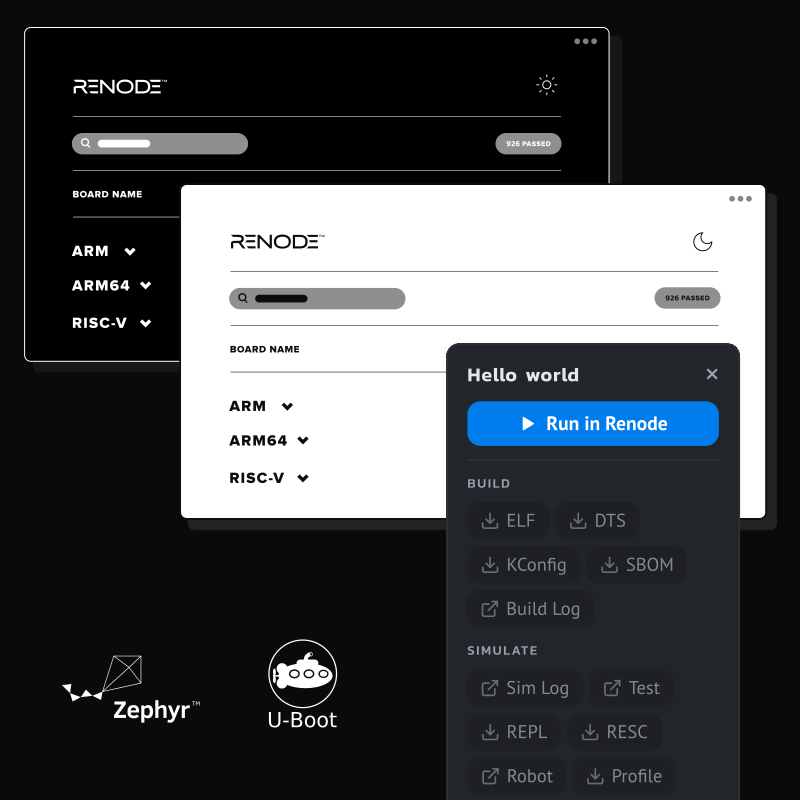
Validated through CI-driven Zephyr and U-Boot testing infrastructure
Antmicro helps customers adopt and extend Renode to build complex systems faster, and without the need for physical hardware: from platform enablement, peripheral modeling and CI systems, to testing infrastructure, custom features and integrations.
Renode is Antmicro's open source development framework for emulating complex computer systems, including CPUs, peripherals, sensors, interconnects and whole multi-node systems. It enables product development teams, silicon teams and hyperscalers to work in absence of physical silicon, automate regression testing and speed up hardware/software co-development.
1200+
Validated through CI-driven Zephyr and U-Boot testing infrastructure
12+
Including ARM, RISC-V and x86
800+
Available out-of-the-box
From simulating complex heterogeneous SoCs and advanced multi-node systems, through pre-silicon and hardware/software co-development, to interactive testing and CI workflows - Renode supports the entire development process.
Pre-silicon prototyping visual
Early firmware and driver development before hardware availability through virtual system execution and ability to run unmodified binaries on target platforms.
Post-silicon system validation visual
Scalable testing of complex hardware-software stacks using execution tracing and observability tooling for debugging real-world system behavior.
Reference system development visual
Serial interfaces
STM32 UART
Sensor models
BME280 I²C Sensor
Storage
W25Q32 SPI Flash
Development of reusable proof-of-concept and reference implementations for heterogeneous multi-core systems and complex multi-node systems.
Developer enablement visual
public void greet (UART *uart){char *str = "Hello, World!";size_t length = strlen(str); for (size_t i = 0; i < length; i++) {uart->DATA = (uint8_t)str[i];}}Enabling developers to build on top of hardware platforms through virtual development environments, CI flows, as well as integrating with external IDEs and tools.
In collaboration with Silicon Labs, we implemented simulation support for 2.4GHz multi-protocol radio interfaces within Renode for the wireless Gecko Series 2 SoCs - allowing teams to validate BLE, Zigbee, Thread and Matter mesh topologies before hardware is available.
Read blog postVirtual wireless lab
Gecko Series 2 · mesh simulation
 Gecko Series 2 SoC
  BLE
BLE Zigbee
 Thread
 Matter
As a Coral NPU ecosystem partner, we help customers in embedding the Coral NPU RTL in SoC designs. Find out how Google's RISC-V-based core can serve as an accelerator for SoCs on the example of the high-performance, ML-enabled NXP i.MX 8M Plus simulated in Renode, and discover what chip makers and teams evaluating new platforms for edge AI devices can achieve with simulation-driven software development.
Read blog post
To enable pre-silicon software validation and hardware-software co-design, we partnered with Microchip to provide Renode simulation support for their PolarFire SoC and their RISC-V Mi-V ecosystem. To further enable developers working with their platforms, we integrated Renode into Microchip SoftConsole via GDB, providing comprehensive debugging functionality.
Read blog post
In a strategic collaboration, Renode has become an integral part of ADI's development environment. Extending Armv8.1-M support in Renode with Helium instructions (M-Profile Vector Extension) allowed for more accurate execution of software that depends on vectorized DSP and ML operations, offering ADI customers more confidence in validating algorithm behavior and application readiness before hardware is available.
Read blog post
Virtual wireless lab
Gecko Series 2 · mesh simulation
Gecko Series 2 SoC BLE Zigbee Thread MatterSystem-on-chip evaluation
Early stage evaluation of hardware platforms and system architectures for validating architectural decisions.

*** Booting Zephyr OS ***
Hello World!
Software development on virtual hardware environments, enabling system integration before production-grade hardware is available.
Agent change
Implement E-stop
Hybrid virtual and physical testing environments enabling software development and debugging of prototype setups.
Renode system integration environment connecting firmware, peripheral models, networks, CI automation and AI workload validation.
End-to-end validation of hardware and software integration with system-level observability and testing workflows prior to production release.
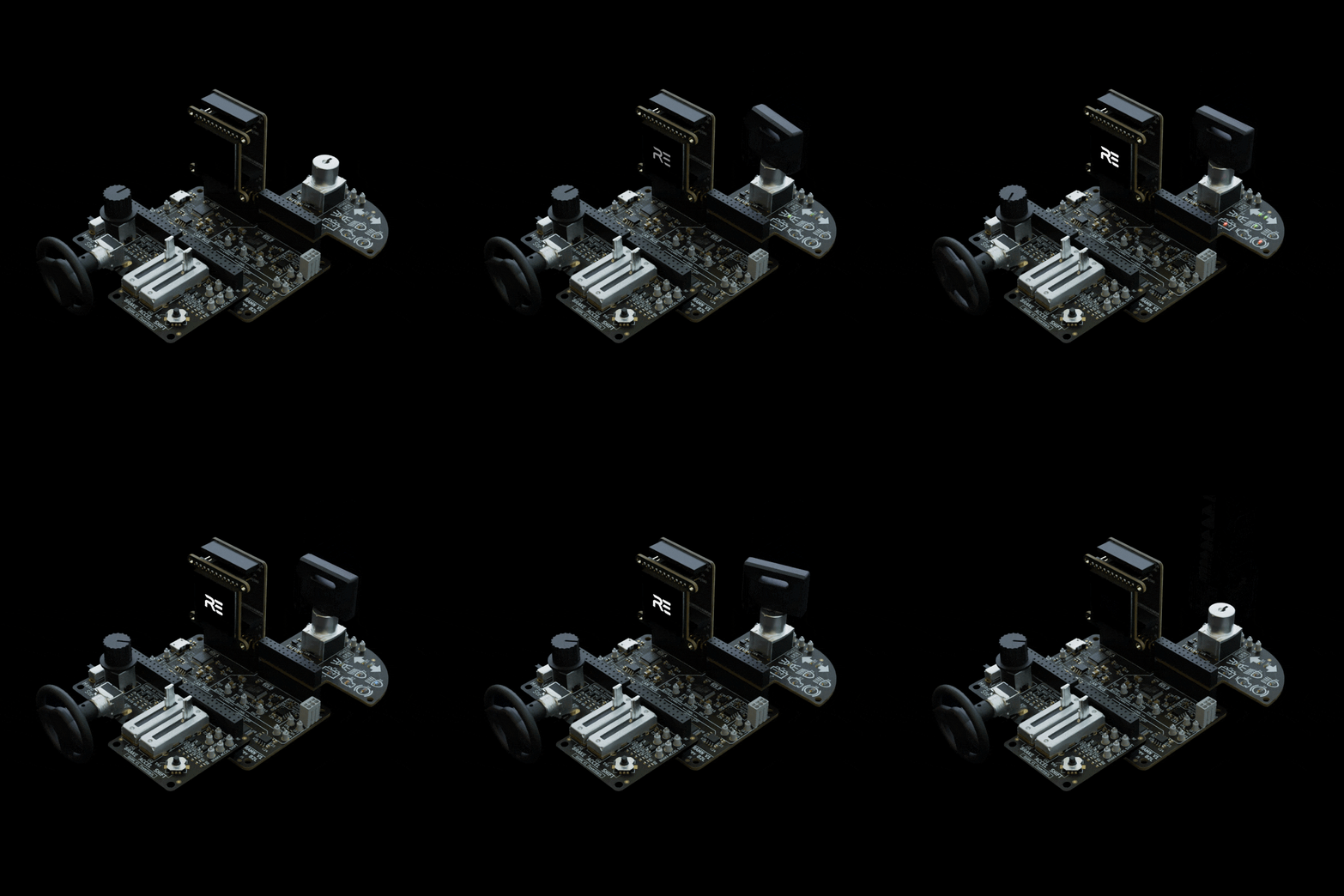
To enable thorough testing of multi-node automotive setups, we added Renode support for the Toyota RAMN - an open source testbed for simulating a multi-node STM-based system communicating over the CAN/CAN-FD network. With Renode support, RAMN can be used without the physical PCB, and also connect to the open source automotive simulator, CARLA, to aid co-simulated development by interacting with the virtual RAMN device controlling a vehicle in the simulator replicating real-world conditions.
Read blog post
In collaboration with the Google ChromeOS team, we've been developing a comprehensive Renode environment for testing the ChromiumOS fingerprint module. To scale the infrastructure and the ChromiumOS EC test suite, we implemented and improved Renode support for numerous platforms, including the STM32F412 and STM32H743 MCUs, Nuvoton NPCX9 controller, as well as the RISC-V Andes D25F core, the related Egis ET171 SoC, and Focaltech FT9001-based targets.
Read blog post
Renode has been instrumental in bringing Aethero's NxN-ECM and NxA-ECM space compute modules from the lab to Low-Earth orbit, enabling the on-board software system to be developed and tested in parallel with hardware across a broad range of scenarios.
Read blog post
[ 01 ]
Assemble your platform using reusable plug-and-play building blocks, or build your bespoke setup from the ground up.
Renode workspace
platform
workspace
▾ renode/
nrf52840.resc
firmware.elf
tests.robot
mach create
include @platforms/cpus/nrf52840.repl
sysbus LoadELF @firmware.elf
system bus connected
[ 02 ]
Run unmodified target software before physical hardware is available, enabling parallel hardware and software development.
Renode workspace
run
Loading: firmware.elf
(monitor) start
Starting emulation…
*** Booting Zephyr OS build v4.x.x ***
[00:00:00.018,000] <inf> app: Running on Renode
uart:~$
PLATFORM
configured
IMAGE
loaded
EMULATION
running
[ 03 ]
Integrate simulation into CI/CD pipelines to perform repeatable testing, catch regressions early and accelerate development lifecycles.
Renode workspace
test
 Verilator
 Questa
 VCS
VCS SystemC
 VS Code
 Arduino IDE
 Eclipse
 GitLab
 GitHub Actions
 Robot Framework
 Travis
 Jenkins
 CircleCI
 CARLA
CARLA ROS 2
ROS 2 Kenning
Explore the continuously updated Renode-driven dashboards for platform support, test results and CI validation across Zephyr and U-Boot.
All boards (1609)
Antmicro provides enterprise support around Renode: enabling new silicon, modeling complex heterogeneous systems, adding peripherals and integrating simulation into CI, testing, modeling and tooling pipelines.
Early firmware and driver development before hardware availability, through virtual system execution and ready-to-use customized models.
Model CPUs, boards and custom hardware for fast bring-up, ecosystem examples and product-scale automation.
Integrate Renode with dashboards, CI systems, trace tooling and workflows already used by your engineering teams and users.
Build scalable testing environments that exercise embedded systems through scripted scenarios, deterministic runs and regression suites.